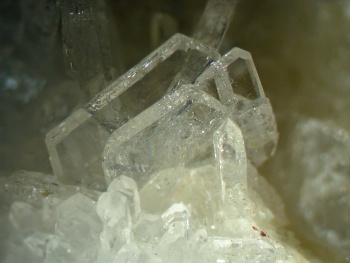
Fracture: conchoidal.
Hardness: 4.5 - 5.
Density: 2.20 to 2.23 gm/cm3.
Luster: vitreous to pearly, iridescent on {010}.
Streak: white.
Biaxial (- or +). α = 1.492 – 1.496, β = 1.497 – 1.499, γ = 1.502 - 1.504, δ = 0.005 - 0.006, 2Vx = 48° - 89°. X ∧ c = 6°-9°, Z = b. Dispersion: r < v, weak to distinct.
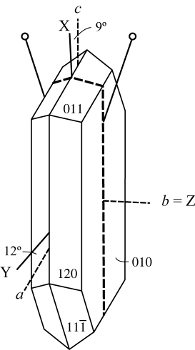
a 9.700, b 13.972, c 10.039 Å, β 111.07°.
Z = 1, Space group Pc.
(Kvick et al. 1986).
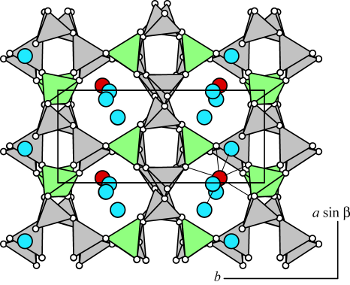
Finally, Cametti and Giordani (2024) reported the investigation of the dehydration process highlighting the presence of a new dehydrated phase (HT-B) at 573 K. This phase has a novel topology, which forms because of the rupture of the T-O-T connections of the tetrahedral framework. Differently from all cases reported in literature so far, the topological change in yugawaralite is not described as a “face-sharing tetrahedra” process (Cametti and Giordani, 2024). The high-pressure behavior of yugawaralite was studied by Fois et al. (2004) and Seryotkin et al. (2024).
Thermal metamorphism of sediment and sedimentary rocks
One of the few instances, in which yugawaralite replaces volcanic
sediment from arc-source terrains, is in the contact metamorphic
aureole of the Tanzawa Mountains, central Japan (Seki et al.
1969). Yugawaralite occurs in the higher temperature half of Zone
II, in which laumontite and other zeolites replace the
fine-grained groundmass of basaltic and andesitic rocks. Besides
laumontite, yugawaralite is associated with analcime, wairakite,
calcite, and quartz. It is also a component in vein and cavity
fillings in the same zone.
More commonly yugawaralite occurs in cavities or veins cutting lavas associated with sedimentary sections that have been weakly metamorphosed. For example, yugawaralite, associated with laumontite and calcite, occurs in cavities of basaltic lavas and pillow breccia at Nukabira, Hokkaido, Japan (Konno and Aoki 1977). The lavas along sediments of the Neogene Horoka Formation have been intruded by andesite causing a very low-grade of metamorphism.
Recently, Yugawaralite is reported for the first time in Costa Rica in the area of Copey de Dota (Obando-Acuña and Murillo-Maikut, 2019). The outcrop has a light gray, well rounded, medium to well sorted, brittle, non-calcareous medium grained sandstones, with volcaniclastic fragments, in this outcrop the Yugawaralite occurs as cement surrounding the clasts. The observed paragenesis is Yugawaralite, Laumontite, Montmorillonite and Calcite, all these minerals are mixed in white massive and brittle aggregates. The Yugawaralite + Laumontite paragenesis, the absence of thermal springs in the area, the presence of silicified rocks nearby due to contact metamorphism caused by mafic intrusions between Copey and Santa María de Dota, suggests a contact metamorphism origin for the zeolites, corresponding to the Zeolite Facies ( Obando-Acuña, Murillo-Maikut, 2019).
Diagenesis of basalt and other kinds of lava flows
There are a few noted occurrences of yugawaralite in basalt
cavities that may have originated from diagenetic alteration of
basalt in regions of high heat flow. Yugawaralite occurs in
cavities of Tertiary basalt at Skalafellshnuta, Skaftafekkssyska
near Heinabergsjokell, southeastern Iceland (Barrer and Marshall
1965, Tschernich 1992, p. 524). Large crystals of yugawaralite
occur with okenite, hydroxyapophyllite, prehnite, and laumontite
in basalt cavities in the Khandivali quarry north of Bombay, India
(Wise 1978). Pongiluppi (1977) describes yugawaralite in cavities
of altered trachyandesite exposed on the slope of Mt. Crastu
Muradu near Osilo, Sassari, Sardinia, Italy. It occurs with
laumontite, heulandite, and stilbite on a substrate of calcite.
Large crystals of yugawaralite occur in veins cutting altered
andesite at Shimoda (Sameshima 1969), and with wairakite at
Toi-cho, both in Shizuoka Prefecture, Japan. Yugawaralite has been
found with heulandite in vesicles, Lower Permian
doleritic intrusives in the northern Takitimu Mountains,
Southland, New Zealand (Houghton 1982).
Hydrothermal systems.
There are several occurrences of yugawaralite in active
hydrothermal systems. Yugawaralite was first described from
Hudo-no-taki Falls near Yugawara Hot Spring, Kanagawa Prefecture,
Japan. It occurs with laumontite and quartz in veins 2 to 5 cm
wide cutting altered andesitic tuff-breccia (Harada et al.
1969). Seki and Okumura (1968) described yugawaralite in a
hydrothermally altered dacitic tuff recovered from drill core at
the Onikobe geothermal area, northeast Japan. The core can be
divided into three zones depending on a key zeolite, mordenite,
laumontite, and wairakite. Although there is some overlap of the
laumontite and wairakite zones, the yugawaralite occurs only with
laumontite. The occurrence is at a depth of 138.7 m and at a
temperature of 110°C.
Bargar and Beeson (1981) and Bargar et al. (1981) describe yugawaralite in core from two drill holes, Y-2 and Y-3 in the Lower Geyser Basin, Yellowstone National Park, Wyoming. Despite the fact that the wall rocks are rhyolitic tuff, several calcic-zeolites occur in these cores. In drill hole Y-2 yugawaralite occurs in a narrow zone at a temperature of about 200°C, and in hole Y-3 it occurs where the temperature is about 270°C.
The presence of yugawaralite and wairakite in the Abanico Hill area indicate an abrupt change in the burial metamorphic effects in an Upper Cretaceous and Tertiary sequence of central Chile (Vergara et al. 1993). Zoning toward a graben indicated by yugawaralite±laumonite and then wairakite±epidote is evidence for a fossil “geothermal-type” alteration overprint on the regional zeolitic burial metamorphism.
The occurrence of yugawaralite along the Chena River east of Fairbanks, Alaska, is in veins cutting a siliceous xenolith (20m by 50m) in a small porphyritic quartz monzonite pluton (Eberlein et al. 1971). The host rock is a brecciated metachert, and fractures are filled or partially filled with yugawaralite associated with quartz, laumontite, stellerite, and stilbite. The occurrence of yugawaralite and laumontite suggest that hydrothermal fluids may have precipitated the zeolites.
Crystals of yugawaralite occur with heulandite, stilbite, and laumontite in veins of hydrothermally altered basalt at Hvalfjordur, Borgafjardarsysla north of Reykjavik, Western Iceland (Tschernich 1992).
Yugawaralite occurs with laumontite, wairakite, calcite, and quartz in Jurassic basaltic rocks of the Letba Formationb (Karoo sequence) along the Mukuze Rover, northwest of Mkuze, northeastern KwaZulu-Natal, South Africa (Weinert et al. 2000). It is suggested that this assemblage formed by thermal metamorphism associated with a local dolerite dike.Alberti, A., Quartieri, S., and Vezzalini, G. (1994) Structural modifications induced by dehydration in yugawaralite. In Zeolites and Related Microporous Materials. State of the Art 1994. Weitkamp, J., Karge, H.G., Pfeifer, H., and Höldrich, W. (eds) Studies in Surface Science and Catalysis 84, 637-644
Artioli, G., Sta?hl, K., Cruciani, G., Gualtieri, A., and Hanson, J. C. (2001). In situ dehydration of yugawaralite. Am. Mineral., 86(1-2), 185-192.
Bargar, K.E. and Beeson, M.H. (1981) Hydrothermal alteration in research drill hole Y-2. Lower Geyser Basin, Yellowstone National Park, Wyoming. Am. Mineral. 66, 473-490.
Bargar, K.E., Beeson, M.H. and Keith, T.E.C. (1981) Zeolites in Yellowstone National Park. Min. Rec. 12, 29-38
Barrer, R.M. and Marshall, D.J. (1965) Synthetic zeolites related to ferrierite and yugawaralite. Am. Mineral. 50, 484-489.
Cametti, G., and Giordani, M. (2024). Humidity-and temperature-dependent study of YUG type zeolite. A new dehydrated topology. Microporous Mesoporous Mater., 363, 112811.
Eberlein, G.D., Erd, R.C., Weber, F. and Beatty, L.B. (1971) New occurrence of yugawaralite from the Chena Hot Springs area, Alaska. Am. Mineral. 56, 1699-1717.
Fois, E., Gamba, A., Tabacchi, G., Quartieri, S., Arletti, R. and Vezzalini, G. (2005) High-pressure behaviour of yugawaralite at different water content: an ab initio study. In Studies in Surface Science and Catalysis (Vol. 155, pp. 271-280). Elsevier.
Gottardi, G. and Galli, E. (1985) Natural Zeolites, Springer-Verlag, Berlin, Germany. 409 pp.
Harada, K., Nagashima, K. and Sakurai, K. (1969) Chemical composition and optical properties of yugawaralite from the type area. Am. Mineral. 54, 306-309.
Houghton, B.F. (1982) Low-grade metamorphism of the Takitimu Group, western Southland, New Zealand. New Zeal. J. Geol. Geophys. 25, 1-19.
Kerr, I.S. and Williams, D.J. (1967) The crystal structure of yugawaralite. Z. Kristallogr. 125, 220-225.
Kerr, I.S. and Williams, D.J. (1969) The crystal structure of yugawaralite. Acta Crystallogr. 25, 1183-1190.
Konno, H. and Aoki, M. (1977) Yugawaralite from Nukabira, Hokkaido. Mineral. Jour. 8, 456-462.
Kvick, Å., Artioli, G. and Smith, J.V. (1986) Neutron diffraction study of the zeolite yugawaralite at 13 K. Z. Kristallogr. 174, 265-281.
Leimer, H.W. and Slaughter, M. (1969) The determination and refinement of the crystal structure of yugawaralite. Z. Kristallogr. 130, 88-111.
Obando-Acuña, L. G., and Murillo-Maikut, S. (2019). Yugawaralite (zeolite) occurrence in Copey de Dota, Costa Rica. Revista Geológica de América Central, (61), 121-130.
Pongiluppi, D. (1977) A new occurrence of yugawaralite at Osilo, Sardinia. Can. Mineral. 15, 113-114.
Sakurai, K. and Hayashi, A. (1952) “Yugawaralite”, a new zeolite. Sci. Rep., Yokohama Nat. Univ., Ser II, 1, 69-77.
Sameshima, T. (1969) Yugawarlite from Shimoda, Shizuoka Prefecture, central Japan. Geoscience Journal (Journal of the Japanese Association of Amateur Mineralogists) 20, 71-78 (Mineralogical Abs. 29-77).
Seki, Y., Oki, Y., Matsuda, T., Mikami, K. and Okumura, K. (1969) Metamorphism in the Tanzawa Mountains, Central Japan. J. Japan. Assoc. Miner Petrol. Econ. Geol., 61, 1-75.
Seki, Y. and Okumura, K. (1968) Yugawaralite from Onikobe active geothermal area, northeast Japan. Jour. Japan. Assoc. Min. Petr. Econ. Geol., 60, 27-33.
Seryotkin, Y.V., Rashchenko, S.V. and Likhacheva, A.Y., (2024) The evolution of yugawaralite structure at high pressure: A single-crystal X-ray diffraction study. Materials Chemistry and Physics, p.129753.
Tanaka, T., Kimura, R., Akizuki, M. and Kudoh, Y. (2002) Origin of low-symmetry growth sectors in edingtonite and yugawarlite, and the crystal structure of the k{011} and v{120} sectors of yugawaralite. Min. Mag. 66, 409-420.
Tschernich, R.W. (1992) Zeolites of the World. Geoscience Press, Tucson, Arizona. 563 pp.
Vergara, M., Levi, B. and Villarroel, R. (1993) Geothermal-type alteration in a burial metamorphosed volcanic pile, central Chile. J. Metam. Geol. 11, 449-454.
Weinert, C.H., Weinert, S.W. and Dunlevey, J.N. (2000) Yugawaralite in the Letaba formation, northeastern KwaZulu-Natal, South Africa. South African J. Geol. 103, 69-73.
Wise, W.S. (1978) Yugawaralite from Bombay, India. Min. Rec. 9, 296.
Updated: January 2026.