| |
|
| Terranovaite |
|NaCa (H2O)13|
[Al3Si17O40] |
| |
|
|
|
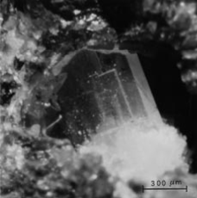
| Morphology: |
|
 |
|
| |
Globular masses and
tabular crystals to 0.7 mm. |
| |
| Physical
properties: |
| |
Cleavage: {010} perfect.
Hardness: not determined.
Density: 2.13 gm/cm3.
Luster: vitreous.
Streak: white.
|
| |
 |
| Optical
properties: |
| |
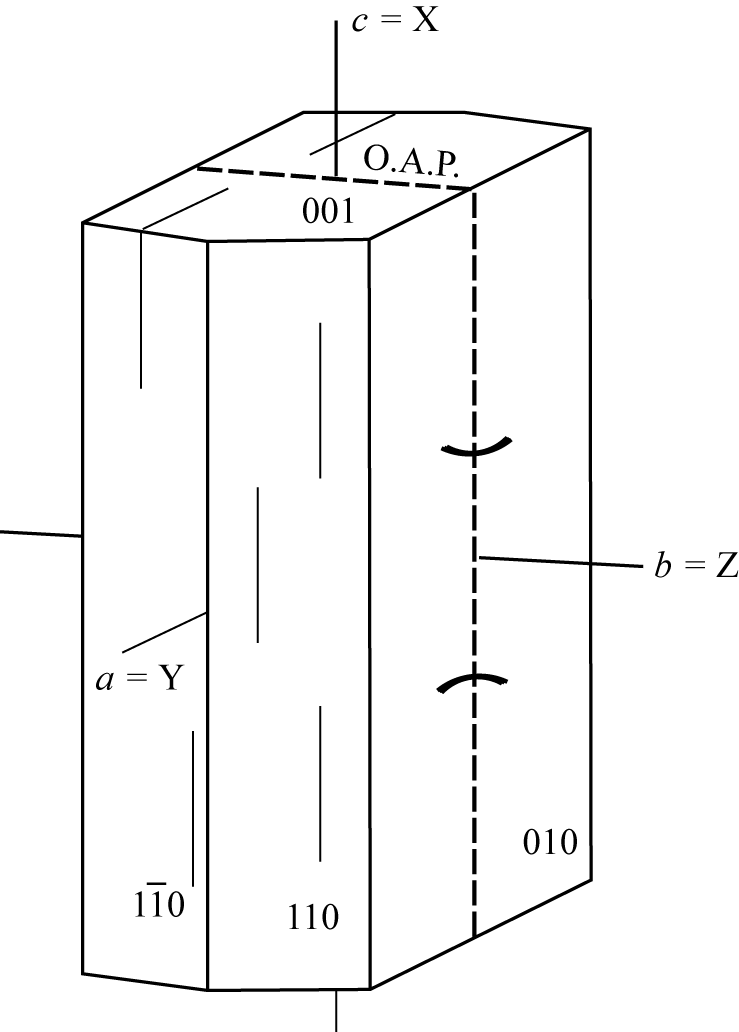
Color: colorless to white;
colorless in thin section.
Biaxial (+). α = 1.476, β = 1.478, γ = 1.483, δ = 0.007, 2Vz =
65°. O.A.P || (100). |
| |
| Crystallography: |
| |
Unit cell
data:
a 9.747, b 23.880, c 20.068 Å,
Z = 4, Space Group Cmcm (Galli et al. 1997) |
| |
| |
| |
|
|
|
| Name: |
|
| |
Terranovaite was described
and named by Galli et al. (1997). The name is for the
Italian Antarctic Station at Terranova Bay, Antarctica, near the
type locality. |
| |
|
|
|
| Crystal structure: |
|
| |
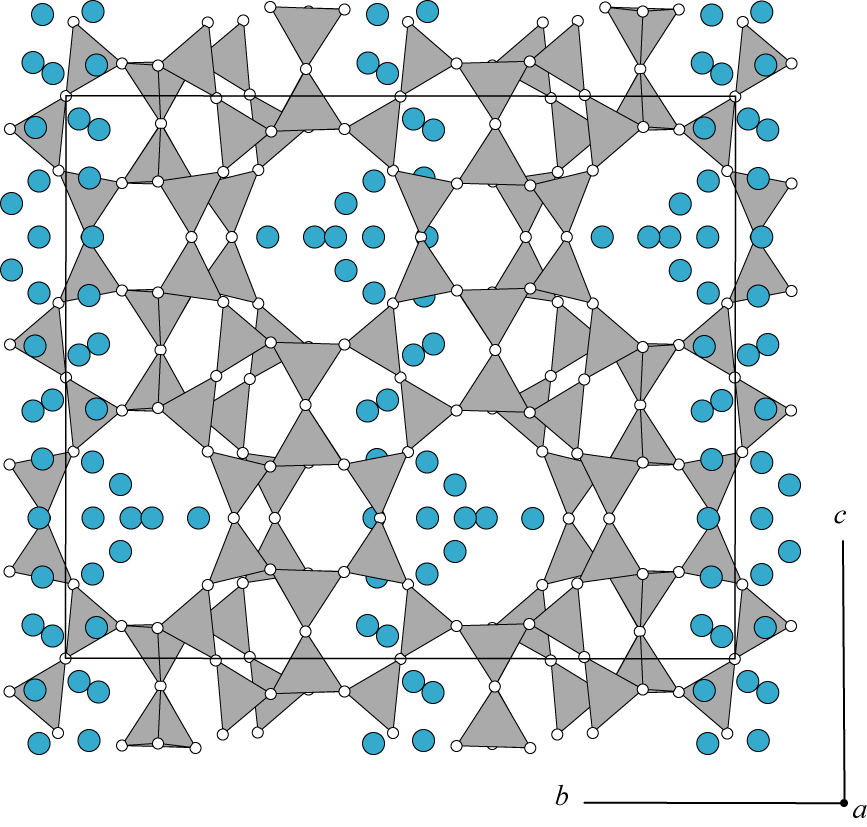
The framework topology of
terranovaite (TER)
(Galli et al. 1997) is characterized by chains of
five-membered rings (pentasil chains) and by a two-dimensional
ten-membered channel system parallel to (010).
Galli et al. (1997) refined the structure in the space
group Cmcm, but argue that the space group C2m
may be more probable. The Cmcm space group allows a
framework oxygen on a center of symmetry and hence an energetically
unfavorable T-O-T angle of 180°. Alberti (1986) showed with work on
other zeolites that such angles may be an indication that the
crystal really has lower symmetry.
The framework is disordered with respect to the Si,Al distribution,
typical of high silica zeolites. Twelve non-framework sites were
located by Galli et al. (1997), and all show weak, broad,
and ill-defined peaks at distances greater than 2.7 Å from a
framework oxygen. This suggests that only weak interaction exists,
and therefore, locating sites for cations was not possible.
|
| |
 |
| |
|
| Chemical composition: |
| |
The only analysis of
terranovaite is reported by Galli et al. (1997). TSi
is 0.846, a high silica zeolite. The structure analysis suggests
that there are more H2O molecules in the channels than
that indicated by the analysis, where H2O was estimated
by difference. Galli et al. (1997) suggest that an H2O
content of 15.50% based on the observed density is more consistent
with the structure refinement. |
| |
|
| Occurrences: |
| |
Terranovaite occurs in the
Ferrar dolerite at Mt. Adamson, Antartica with other zeolites,
mordenite, heulandite, erionite, phillipsite, stilbite, levyne,
epistilbite, tschernichite, boggsite, gottardiite, ferrierite, and
cowlesite (Vezzalini et al. 1995). Other associated minerals in the cavities are quartz,
cristobalite, apophyllite, gypsum, and calcite. Galli et al.
(1997) remark that the strong disorder in extra-framework cation
distribution and very large atomic displacement parameters “indicate
that somewhat special conditions were involved in the
crystallization of these zeolites, such as rapid cooling during
crystal growth.” |
| |
|
| References: |
| |
Alberti, A. (1986) The
absence of T-O-T angles of 180° in zeolites. In, Murakami, Y.,
Iijima, A., Ward, J.W. (eds) New developments in Zeolite
Science and Technology. Proceedings of the 7th International
Zeolite Conference, Kodansha, Tokyo, 437-441.
Galli, E. Quartieri, S., Vezzalini, G., Alberti, A., and Franzini,
M. (1997) Terranovaite from Antarctica: a new ‘pentasil’ zeolite. Amer.
Mineral. 82, 423-429.
Vezzalini, G., Alberti, A., Galli, E. and Quartieri, S. (1995) A new zeolite
topology: terranovaite from Antarctica. Plinius: 14: 170-172.
Updated: December 2025.
|