Stilbite-Na |(Na,Ca0.5, K)9(H2O)26|[Al9 Si27 O72]
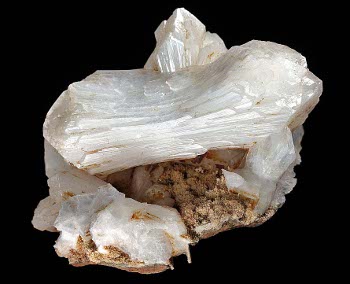
Hardness: 4 – 4.5.
Density: 2.14 – 2.21 gm/cm3.
Luster: vitreous, pearly on {010}.
Streak: white.
Biaxial ( -)
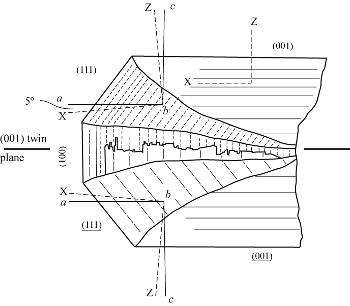
2Vx 30 - 50° Y = b, X ∧ a 5°
Dispersion: r < v, moderate
2Vx 45°, Y = b, X ∧ c 9° Dispersion: r < v, moderate
The framework type (STI) of the stilbite group, which includes stilbite series, stellerite, and barrerite, consists of two sets of connected channels. One channel extends parallel to the a-axis and is confined by a ten-membered ring (aperture 4.9 x 6.1 Å). The other channel (aperture 2.7 x 5.6 Å) is located along [101] for monoclinic frameworks or [001] for orthorhombic structure and is confined by an eight-membered ring. Both of these channels are in the (010) plane, creating a structural weakness across the plane leading to perfect (010) cleavage and a tabular habit.
Two different orientations have long been used to describe the
crystallography of stilbite, the proper monoclinic setting with
the β angle near 127° and a pseudo-orthorhombic setting with β
near 91°. The second is commonly used for ease of comparison with
crystal forms and crystal structures of stellerite and barrerite.
Optical studies of stilbite have shown that within one macroscopic
single-crystal, monoclinic (F2/m) and
orthorhombic (Fmmm) coexist depending on the growth
direction (Akizuki and Konno 1985). See diagram above. Akizuki et
al. (1993) also studied the symmetry of different growth sectors
in stilbite by single-crystal diffraction and refined the
structure of an orthorhombic {001} growth sector yielding space
group Fmmm, a = 13.616, b = 18238, c
= 17.835 Å within a chemically homogeneous crystal. This structure
represents a disordered variant of the monoclinic F2/m
structure of stilbite where higher symmetry occurs on a
submicroscopic scale rather than microscopically as in {101}
growth sectors. Galli (1971) and Akizuki et al (1993)
implied complete (Si,Al) disorder based upon average T-O
distances. Slaughter (1970) and Quartieri and Vezzalini (1987)
assumed pronounced (Si,Al) ordering, with Al contents varying
between 11 and 40% in the different tetrahedral sites.
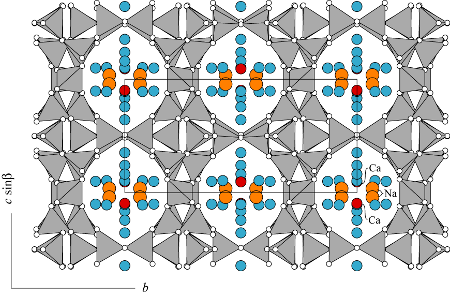
All refinements done in monoclinic symmetry yielded one fully
occupied Ca (red) site located near the middle of the ten-membered
ring parallel to the a-axis (see the figure). Ca is
bonded only to channel H2O molecules and not to
framework oxygens. Galli (1971) and Quartieri and Vezzalini (1987)
found one partially occupied Na site (orange) that is
seven-coordinated to two framework oxygens and five channel H2O
molecules. Slaughter (1970) interpreted the Ca site to contain a
small amount of Na and found three partially occupied Na sites and
another undifferentiated partially occupied metal sites. The
dehydration dynamics of stilbite was studied by Cruciani et
al. (1997) using synchrotron X-ray powder diffraction.
Upon heating, Cametti et al. (2017) demonstrated that Na-stilbite
(at RT monoclinic, space group F2/m) displayed the same structural
modifications as observed in natural barrerite, and adopted space
group A2/m. The total volume contraction was ?16% at 350 °C compared to
?8% of pristine material. Under high pressure conditions, the cations
coordination changes mainly through minor shifts of water positions and
some re-distribution of their occupancy. Above 3 GPa the structure abruptly
contracts along the b axis; the structure symmetry is reduced to triclinic
(Seryotkin et al. 2021).
By far the most common composition of this series is stilbite-Ca.
The framework composition is moderately silica rich with Si
varying between 25.3 and 28.2 per unit cell or TSi between 0.706
and 0.785. Ca and Na are the common non-framework cations and form
a compositional series. K occurs rarely, while other elements like
Mg, Sr, and Ba are absent or very minor in amount. As shown by
Passaglia et al. (1978) there is no compositional gap
between stellerite and stilbite. Typically stilbite-Ca contains
four Ca per unit cell and variable amounts of Na, from near zero
to greater than 2. Only a few stilbite-Na samples are known, and
these have Na in excess of four and Ca between 1 and 2 cations per
cell.
The H2O content of members of this series depends on the number of
cations in the channels. Stilbite-Ca contains between 28 and 30 H2O
molecules per cell, while stilbite-Na with 7 to 8 cations per cell
has 25 to 26 H2O molecules per unit cell (Deer et al.
2004).
Diagenesis and burial metamorphic environments.
Minerals of the stilbite series are rare
constituents of diagenetically altered or weakly metamorphosed
volcaniclastic sedimentary rocks. Stilbite is
virtually unknown in deep sea sediment samples, although traces of
stilbite have been detected in merlinoite-bearing, manganese
nodule samples from the Central Indian basin, Indian Ocean
(Mohatapatra and Sahoo 1987).
Stilbite, presumably stilbite-Ca, occurs in widely scattered
localities in the altered Tertiary volcanic sedimentary sequences
in Japan (Iijima and Utada 1972). The rare occurrences of stilbite
in the thermal aureole in the Tanzawa Mountains of central Japan
are believed by Seki et al. (1969) to occur only in
mafic host rocks in Zone I, where mordenite is characteristic in
silicic protoliths.
An important, but under-reported, occurrence of stilbite is in
veins cutting sedimentary rocks that have been altered to
heulandite or laumontite. Two such occurrences were briefly
described by Coombs (1954) in Triassic sediments of the Southland
Syncline, South Island, New Zealand, and by Murata and Whiteley
(1973) in Miocene sandstone formation of the Central Coast Rages,
California. These fractures are obviously post-diagenesis and may
represent a retrograde reaction, like heulandite (in wall-rock) +
H2O = stilbite.
Murata and Whiteley (1973) observed both stilbite and heulandite
replaced by laumontite in some veins. Stallard and Boles (1989)
and Boles (1991) used oxygen isotope compositions of vein stilbite
to estimate the temperature of formation. Assuming a vein water of
about -2 per mil (a mix of marine pore water about 0 per mil and
meteoric water -6 to -12 per mil) the crystallization temperature
of stilbite ranges from 62° to 78°C through the 10 km of exposed
section.
Zeolite in Alpine amphibolite facies rocks of the Gotthard massif
and the Lepontine Alps formed during fluid-induced decomposition
and albitization of plagioclase (Bucher and Weisenberger, 2013).
Crystals typically occur in aggregates of variable size and shape
but rarely as isolated crystals. Observed crystal morphologies include
sheaf-type, bowtie, globular, radially fibrous and columnar. The {010}
plane is the prominent plane, which is the contact plane for crystal
aggregates (Bucher and Weisenberger, 2013). Stilbite, in general, is
transparent to translucent, colorless to white. Globular stilbite from
surface outcrops in the Rien valley hosted in quartz veins occurs as
light reddish to brownish aggregates (Weisenberger and Bucher 2010).
Diagenesis and alteration of mafic lava flows.
By far the most notable stilbite-Ca occurrences are in
cavities in tholeiitic basalt. Specimens of crystals up to 10 cm
have been collected from the classic localities, such as
Teigarhorn and Roudafell in Berufjord, eastern Iceland; Nasik and
Pune, India; Faroe Islands; Minas Basin and the Bay Fundy, Nova
Scotia, Canada; the Glascow area, Scotland; and quarries in and
near Paterson and Prospect Park, New Jersey, U.S.A. Descriptions,
including associated minerals, of these occurrences and many more
are given by Tschnerich (1992).
Few studies have explored the conditions controlling this type of
occurrence of stilbite. However, several investigations of the
alteration of basalt flow sequences in Iceland may be extended to
other localities, to estimate the physicochemical
conditions of stilbite crystallization. Particularly informative
are those on the eastern Iceland localities (Walker 1960) and the
geothermal areas near Reykjavik (Kristmannsdóttir and Tómasson
1978). Zonal distribution of zeolite species in the thick
sequences of Tertiary basalt in eastern Iceland show stilbite in
the lowest zone with mesolite and scolecite (Walker 1960). This
zone is about 800 m thick, and the maximum burial depth of the top
of the zone was about another 800 m. Similar assemblages occur in
the low temperature, geothermal areas of Reykjavik at temperatures
from 90° to 110°C and depths of 900 to 1000 m (Kristmannsdóttir
and Tómasson 1978). These conditions show that the
stilbite-bearing zone formed in a region of moderately high heat
flow (65° to 125° per kilometer). Murata et al. (1987)
suggest that regional zoning of zeolites in cavities of lavas
occurs in regions of high heat flow, like spreading centers.
Whereas localized zeolite occurrence is typical of low heat flow
areas, such as in fore-arc basins.
Although stilbite-Ca is a common alteration product of basalt, its
abundance is controlled by the bulk composition of the host rock.
Because of its relatively high TSi content, stilbite-Ca tends to
occur in tholeiitic basalt or basaltic andesite (Walker 1960,
Murata et al. 1987). In Iceland, for example, the major
stilbite occurrences are in the tholeiitic basalt flows, and not
in the olivine basalt buried to the same depths.
Stilbite-Na is uncommon, and the known occurrences in basalt
cavity localities are from sea-side localities. The type locality
is at Capo Pula, Cagliari, Sardinia in altered andesite in sea
cliffs (very near the type locality of barrerite). Other
occurrences are in the Victorian basalt, exposed on Phillip
Island, Victoria, Australia (Birch 1989) and in basalt exposed in
the tidal area of Kuiu and Kupreanof Islands in southeastern
Alaska (Di Renzo and Gabelica 1997). Passaglia et al.
(1978) and Di Renzo and Gabelica (1997) suggest that the unusually
high Na contents for stilbite are related to the proximity
of the localities to sea water. It is not clear whether the Na
contents result from sea water control of the altering solutions
or from later ion exchange with sea water.
More recently, Cairncross and du Plessis (2018) reported the
occurrence of stilbite in the Butha-Buthe District, Lesotho,
Southern Africa. The exact species of the Lesotho stilbite has not
yet been determined but is presumed to be the calcium-rich end member.
The color varies from white to off-white to salmon-pink on some fresh
specimens, although this color is relatively rare. Individual crystal
size varies from less than 1 cm to 7 cm. The smaller crystals can be
partially transparent; larger crystals are opaque. Twinned bow-tie
forms are relatively common.
Natural stilbite filling amygdales and veins in tertiary basaltic
host rocks on the Isle of Skye (NW Scotland) have been reported by
Triana et al. (2012). Zeolite formation in the Skye basalts began
with low Si/Al ratio Na zeolites and a gradual increase in Ca content
and Si/Al ratio, ending up as Ca zeolites. They were probably formed
as a consequence of late-stage hydrothermal activity, although, locally,
contact metamorphism may control the process of zeolite formation.
Natural stilbite was also identified over the outcrop area of the Late
Cretaceous Cayo Formation of Coastal Ecuador (Machiels et al. 2014).
Here stilbite occurs over nearly the entire outcrop area and the entire
stratigraphical thickness of the Cayo Formation in association with
Ca-heulandite-type zeolites (clinoptilolite and heulandite), mordenite,
laumontite, analcime, epistilbite, chabazite, thomsonite and erionite.
Hydrothermal systems.
Stilbite does not occur in rocks near many active
geothermal systems, largely because the wall rocks are commonly
rhyolitic and the temperatures too high. As mentioned above,
stilbite-Ca has been found in basaltic rocks of the low
temperature geothermal area near Reykjavik, Iceland, where occurs
in the same zone as thomsonite, heulandite, and mordenite, 90° to
110°C and depths 800 to 1000 m (Kristmannsdóttir and Tómasson
1982).
Zeolites, stilbite in particular, are rare in epithermal ore
veins. A notable occurrence, however, is at the Samson Mine,
Andreasberg, Harz, Germany, where stilbite-Ca (Passaglia et
al. 1978, Haüy 1801) occurs with heulandite, analcime,
calcite, pyrite, quartz, fluorite, and galena.
Stilbite-Ca has long been known to occur in veins and other
cavities in hypabyssal and plutonic rocks. The stilbite may form
from fluids passing through joints or faults during late stages of
crystallization, but also from retrograde reactions during uplift
events. Some such occurrences are in tonalite, Val Nambrone,
Trento, Italy (Alberti 1971); with chabazite and laumontite in the
granite of Baveno near Lago Maggiore, Italy (Pagliani 1948); in
the Camas Land gabbro, Washington, USA, where stilbite replaces
plagioclase (Chappell 1933); and with laumontite in a breccia zone
in granodiorite near the scheelite ore body of the Pine Creek
Mine, Bishop, California, USA (Gray et al. 1968). The
surface manifestation of this environment of alteration may be
represented by hot springs, like those described by Mariner and
Presser (1995). Stilbite-Ca and chabazite-Ca line fractures and
cement cobbles in terraces associated with hot springs in the
Idaho batholith, central Idaho, U.S.A. Spring waters that
precipitated these zeolites are alkaline and are at temperatures
in the range 50° to 86°C (Mariner and Presser 1995). In Japan
stilbite-Na occurs in cavities in a Miocene granite porphyry on
the Kii Peninsula, Onigajo, Mié Pref. (Harada and Tomita 1967).
Stilbite-Na forms the drusy lining of cavities and is covered by
heulandite and finally by laumontite, suggesting a temperature
increasing sequence.
Stilbite also occurs in granitic rocks as a late stage deuteric
(hydrothermal) alteration product of feldspars or other
Ca-silicates. Examples are in the pocket zones of pegmatite dikes,
such as the Himalaya dike, San Diego County, California (Foord,
1977); the dike at Jensen Quarry, Riverside County, California
(DeVito and Ordway, 1984); at Elveneset, Innhavet, Norway (Saebø
and Sverdrup 1959); and near San Piero in Campo, Elba, Italy
(Orlandi and Scortecci 1985).
Stilbite-Ca occurs as a low temperature alteration product along
fractures in several kinds of metamorphic rocks, for example the
alpine-clefts in the granitic gneiss of the Aar Massif,
Switzerland (Parker 1922). Of the many occurrences in Switzerland
described by Stalder et al. (1973) a few notable ones
are Pedemonte, Bellinzona, Tessin (Gschwind and Brandenberger
1932); Gibelsbach near Fliesch (Stalder et al. 1973);
and Schirstock, Fellithal, Uri (Passaglia et al. 1978).
In some cases, it remains questionable whether reported stilbite-Ca
is really stilbite and not stellerite (e.g., Armbruster et al.
1996). Similar vein occurrences have been found in the eastern
U.S., in gneiss at the Tilly Foster Mine near Brewster, New York,
USA (Trainer 1938); along subway excavations in New York City
(Manchester 1931); also in gneiss at Jones Falls, Maryland
(Shannon 1925); and several localities in Connecticut, like in the
gneiss and granite at Thachersville (Dana 1899)
Akizuki, M and Konno, H. (1985) Order-disorder structure and the internal texture of stilbite. Am. Mineral. 70, 814-821.
Akizuki, M., Kudoh, Y. and Satoh, Y. (1993) Crystal structure of the orthorhombic {001} growth sector of stilbite. Eur. J. Mineral. 5, 839-843.
Armbruster, T., Kohler, T., Meisel, T., Nägler, T., Götzinger, M.A., and Stalder, H.A. (1996) The zeolite, fluorite, quartz assemblage of the fissures at Gibelsbach, Fiesch (Valais, Switzerland): crystal chemistry, REE patterns, and genetic speculations. Schweiz. Mineral. Petrogr. Mitt. 76, 131-146.
Birch, W.D. (1989) Zeolites of Victoria, Mineral. Soc. Victoria (Australia), Sp. Pub. No. 2.
Boles, J.R. (1991) Diagenesis during folding and uplift of the Southland Syncline, New Zealand. New Zealand Jour. Geol. and Geophys. 34, 253-259.
Bucher, K., and Weisenberger, T. B. (2013). Fluid-induced mineral composition adjustments during exhumation: the case of Alpine stilbite. Contributions to Mineralogy and Petrology, 166, 1489-1503.
Cairncross, B. and, du Plessis, H. (2018). Stilbite and Associated Minerals from the Butha-Buthe District, Lesotho, Southern Africa. Rocks & Minerals, 93(4), 306–319.
Cametti, G., Fisch, M., and Armbruster, T. (2017). Thermal behavior of stilbite and stellerite revisited and dehydration of their Na-exchanged forms: Considerations on the memory effect of the STI framework type. Microporous Mesoporous Mater., 253, 239-250.
Chappell, W.M. (1933) Paulopost stilbite in the Camas Land sill, Chelan County, Washington. Am. Mineral. 18, 440-
Coombs, D.S. (1954) The nature and alteration of some Triassic sediments from Southland Syncline, New Zealand. Trans. Royal Soc., New Zealand, 82, 65-109.
Coombs, D.S., Alberti, A., Armbruster, T., Artioli, G., Colella, C., Galli, E., Grice, J.D., Liebau, F., Mandarino, J.A., Minato, H., Nickel, E.H., Passaglia, E., Peacor, D.R., Quartieri, S., Rinaldi, R., Ross, M., Sheppard, R.A., Tillmanns, E., and Vezzalini, G. (1997) Recommended nomenclature for zeolite minerals: Report of the Subcommittee on Zeolites of the International Mineralogical Association, Commission on New Minerals and Mineral Names. Can. Mineral., 35, 1571-1606.
Cruciani, G., Artioli, G., Gualtieri, A., Ståhl, K., and Hanson, J.C. (1997) Dehydration dynamics of stilbite using synchrotron X-ray powder diffraction. Am. Mineral. 82, 729-739.
Dana, E.S. (1899) The system of mineralogy of James Dwight Dana. 6th Ed. John Wiley and Sons, New York, 1134 pp.
Deer, A., Howie, R., Wise, W.S., and Zussman, J. (2004). Rock
Forming Minerals. vol. 4B.
Framework Silicates: Silica Minerals, Feldspathoids and the
Zeolites. The Geological Society, London.
DeVito, F. and Ordway, A., Jr. (1984) The Jensen Quarry, Riverside County, California. Min. Rec. 15, 273-290.
Foord, E.E. (1977) The Himalaya dike system, Mesa Grande District, San Diego County, California. Min. Rec., 8, 461-474.
Galli, E. (1971) Refinement of the crystal structure of stilbite. Acta Crystallogr. B27, 833-841.
Galli, E. and Gottardi, G. (1966) The crystal structure of stilbite. Mineral. Petrogr. Acta (Bologna) 12, 1-10.
Gray, R.F., Hoffman, V.J., Bagan, R.J. and McKinley, H.L. (1968) Bishop Tungsten District, California. Ore Deposits of the United States, 1933-1967, the Graton-Sales Volume, Ridge, J.D. (ed), 2, 1531-1554.
Gschwind, M. and Brandenberger, E. (1932) Über zwei neue Zeolithvorkommen im Tessin. Schweiz. Mineral. Petrog. Mitt., 12, 445.
Harada, K. and Tomita, K. (1967) A sodian stilbite from Onigajo, Mie Prefecture, Japan with some experimental studies concerning the conversion of stilbite to wairakite at low water vapor pressures. Am. Mineral. 52, 1438-1450.
Haüy, A.R. (1801) Traité de Minéralogie. 3, Ches Louis, Paris.
Iijima, A. and Utada, M. (1972) A critical review on the occurrence of zeolites in sedimentary rocks in Japan. Japan. J. Geol. Geogr., 42, 61-83.
Kristmannsdóttir, H. and Tómasson, J. (1978) Zeolite zones in geothermal areas in Iceland. In, Sand, L.B. and Mumpton, F.A. (eds). Natural Zeolites: Occurrence, Properties, Use, Pergamon Press, Elmsford, New York, 277-284.
Machiels, L., Garces, D., Snellings, R., Vilema, W., Morante, F., Paredes, C., and Elsen, J. (2014). Zeolite occurrence and genesis in the Late-Cretaceous Cayo arc of Coastal Ecuador: Evidence for zeolite formation in cooling marine pyroclastic flow deposits. Applied Clay Science, 87, 108-119.
Manchester, J.G. (1931) The minerals of New York City and its environs. Bull. New York Mineral. Club 3, 1-168.
Mariner, R.H. and Presser, T.S. (1995) Conditions of stilbite and chabazite formation in hot springs of the Idaho batholith, Central Idaho. In Ming, D.W. and Mumpton, F.A. (eds). Natural Zeolites ‘93, Int. Comm. Natural Zeolites, Brockport, New York, 565-577.
Mohatapatra, B.K. and Sahoo, R.K. (1987) Merlinoite in manganese nodules from the Indian Ocean. Min. Mag. 51, 749-750.
Murata, K.J., Milton, L.I., Formoso, L.L., and Roisenberg, A. (1987) Distribution of zeolites in lavas of southeastern Parana Basin, State of Rio Grande do Sol, Brazil. J. Geol., 95, 455-467.
Murata, K.J. and Whiteley, K.R. (1973) Zeolites in the Miocene Briones Sandstone and related formations of the central Coast Ranges, California. J. Res. U.S. Geol. Surv., 1, 255-266.
Orlandi, P. and Scortecci, P.B. (1985) Minerals of the Elba Pegmatites. Min. Rec., 16, 353-363.
Pagliani, G. (1948) Le zeoliti del granito di Baveno. Period. Miner. 17, 175-188.
Parker, R.L. (1922) Über einige schweizerische Zeolithparagenesen. Schweiz. Mineral. Petrog. Mitt., 2, 290-298.
Passaglia, E., Galli, E., Leoni, L. and Rossi, G. (1978) The crystal chemistry of stilbites and stellerites. Bull. Minéral. 101, 368-375.
Quartieri, S. and Vezzalini, G. (1987) Crystal chemistry of stilbites: structure refinements of one normal and four chemically anomalous samples. Zeolites, 7, 163-170.
Saebø, P.C. and Sverdrup, T.L. (1959) Note on stilbite from a pegmatite at Elvenset, Innhavet in Nordland Co., northern Norway. Norg. Geol. Unders. 205, 181-183.
Seki, Y., Oki, Y., Matsuda, T., Mikami, K. and Okumura, K. (1969) Metamorphism in the Tanzawa Mountains, Central Japan. J. Japan. Assoc. Miner Petrol. Econ. Geol., 61, 1-75.
Seryotkin, Y.V., Dementiev, S.N. and Likhacheva, A.Y. (2021) Crystal–fluid interaction: the evolution of stilbite structure at high pressure. Phys. Chem. Mineral., 48, 1-11.
Shannon, E.V. (1925) The so-called halloysite of Jones Falls, Maryland. Am. Mineral. 10, 159-161.
Slaughter, M. (1970) Crystal structure of stilbite. Am. Mineral. 55, 387-397.
Stalder, H.A., de Quervain, F., Niggli, E., Graeser, St. and Jenny, V. (1973) Die Mineralfunde der Schweiz, revised edition of Parker, R.L. Die Mineralfunde der Schweizer Alpen, Wepf and Co, Verlag, Basel. 433 pp.
Stallard, M.L. and Boles, J.R. (1989) Oxygen isotope measurements of albite-quartz-zeolite assemblages, Hokunui Hills, Southland, New Zealand. Clays and Clay Minerals. 37, 409-418.
Trainer, J.N. (1938) Tilly Foster up-to-date. Rocks and Minerals, 13, 291-303.
Triana R, J. M., Herrera R, J. F., Ríos R, C. A., Castellanos A, O. M., Henao M., J. A., Williams, C. D., and Roberts, C. L. (2012). Natural zeolites filling amygdales and veins in basalts from the British Tertiary Igneous Province on the Isle of Skye, Scotland. Earth Sciences Research Journal, 16(1), 41-53.
Tschernich, R.W. (1992) Zeolites of the World. Geoscience Press, Tucson. 563 pp.
Walker, G.P.L. (1960) Zeolite zones and dike distribution in relation to the structure of the basalts of eastern Iceland. J. Geol., 68, 515-528.
Weisenberger, T. and, Bucher, K. (2010). Zeolites in fissures of granites and gneisses of the Central Alps. J. Metamorph. Geol. 28(8), 825–847.
Updated: December 2025.