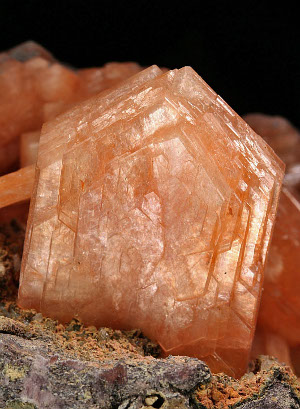
Hardness: 4 – 4.5
Density: 2.13 gm/cm3.
Luster: vitreous, pearly on {010}.
Streak: white
Biaxial (-).
α = 1.485, β = 1.496, γ = 1.498, δ = 0.013, 2Vx = 45°. a = X, b = Y, c = Z.
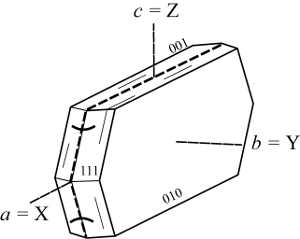
a 13.600, b 18.222, c 17.863 Å.
Z = 2, Space group Fmmm
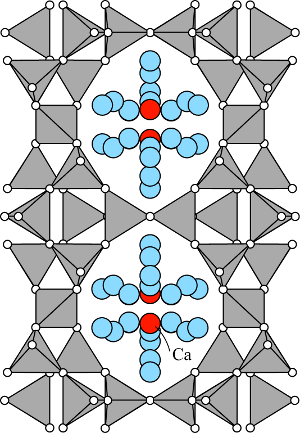
The framework topology of stellerite is the same as stilbite (STI),
and with mostly Ca in the channels is orthorhombic, space group Fmmm
(Galli and Alberti 1975, Miller and Taylor 1985). The neutron
diffraction data of Miller and Taylor (1985) disclosed slight
(Si,Al) ordering with individual tetrahedral Al contents ranging
from 10 to 30%.
Stellerite has only one fully, or nearly fully occupied, Ca
channel cation site (red) (Galli and Alberti 1975, Miller and
Taylor 1985). Ca is coordinated only to channel H2O
molecules (blue) and not to framework oxygens. Similar to
stilbite, the Ca(H2O) complex is hydrogen bonded to the
framework oxygens (Miller and Taylor 1985). There are seven
partially occupied H2O sites in the structure with occupancies
between 0.2 and 0.8 (Galli and Alberti 1975, Colella and
Gualtieri 2007).
A different topology of stellerite is generated if heated at conditions near (Alberti and Vezzalini, 1978) or far from equilibrium conditions (Arletti et al. 2006; Kaneva and Shendrik, 2022); in both cases breaking occurs but on different T–O–T bridges belonging to the same 4-ring (Alberti and Martucci 2011). More recently, the differences in the crystal structures of stellerite heated under different conditions were extensively investigated by Cametti et al. (2017). Upon compression, stellerite undergoes pressure-induced hydration, in which H2O molecules first occupy partly vacant sites and then the initially vacant positions (Seryotkin 2022).
Several of the known stellerite occurrences are in cavities of basalt. The type locality on Copper Island, Commander Islands (Kommandorskiye Ostrova), Russia, Bering Sea, is in brecciated basaltic rocks. Galli and Passaglia (1973) describe stellerite from lower Miocene andesitic breccia, exposed near Villanova Monteleone, Sardinia, Italy. Large crystals of stellerite occur in the Garrawilla Volcanics (Jurassic flows interbedded in sandstone), New South Wales, Australia (England and Sutherland 1988). Exceptional specimens have been found at Jalgaon, Maharashtra, India. There are no clear indications of why stellerite crystallized in these localities rather than stilbite-Ca, except for the lack of Na.
Hydrothermal systems.
The occurrences of stellerite in plutonic and metamorphic
rocks are so similar to those of stilbite-Ca that paragenesis
cannot be used to distinguish the two minerals. Like stilbite,
stellerite occurs in some hydrothermal ore veins. One notable
example is east of Kiruna, Sweden, at the old copper mine next to
the Leveäniemi mine. This is the locality of the mineral, for
which the name zeolite was first coined (Cronstedt 1756,
Colella and Gualtieri 2007).
Stellerite occurs in alteration cavities in pegmatite near Dassau, Baltistan, Northern Territories, Pakistan. Among many occurrences of stellerite in retrograde vein fillings cutting metamorphic rocks, the following are examples: at the Malmberget Iron Mine, Lappland, Sweden (Passaglia et al. 1978); in granitic gneiss at Siglitztal near Brokstein, Austria (Passaglia et al. 1978). Stellerite occurs as a low temperature alteration product along fractures in several kinds of metamorphic rocks: in alpine-clefts in the granitic gneiss of the Aar Massif, Switzerland (Armbruster et al. 1996), in thin veins in dioritic and granitic gneiss at Kongsberg, Norway (Neumann 1944); in schists on the island of Magerø, Norway (Saebø et al. 1959); in the calc-schist of Val Varenna, Liguria, Italy (Pelloux 1949); and in an granite porphyry in China (Young 1965).
More recently, Stellerite has been found by Leavens et al. (2019) in the one large, horizontal pocket at Dyer quarry, which must have had a different origin than the fracture fillings. Stellerite is also abundant in fracture fillings and pockets in the hornfels adjacent to diabase at Kibblehouse quarry, where it is associated with chabazite, calcite, and an inadequately studied chlorite like mineral.
Alberti, A. and Vezzalini, G. (1978). Crystal structures of heat-collapsed phases of barrerite. In L.B. Sand and J. Mumpton, Eds., Natural Zeolites. Occurrence, Properties, Use, p. 85-98. Pergamon Press, Oxford and New York.
Arletti, R., E. Mazzucato, and G. Vezzalini (2006). Influence of dehydration kinetics on TOT bridge breaking in zeolites with framework type STI: The case of stellerite. Am. Mineral. 91.4, 628-634.
Armbruster, T., Kohler, T., Meisel, T., Nägler, T., Götzinger, M.A., and Stalder, H.A. (1996) The zeolite, fluorite, quartz assemblage of the fissures at Gibelsbach, Fiesch (Valais, Switzerland): crystal chemistry, REE patterns, and genetic speculations. Schweiz. Mineral. Petrogr. Mitt. 76, 131-146.
Cametti, G., Fisch, M., and Armbruster, T. (2017). Thermal behavior of stilbite and stellerite revisited and dehydration of their Na-exchanged forms: Considerations on the memory effect of the STI framework type. Microporous Mesoporous Mater., 253, 239-250.
Colella, C. and Gualtieri, A.F. (2007) Cronstedt’s zeolite. Microporous Mesoporous Mater. 105, 213-221.
Cronstedt, A.K. (1756) [Observation and description of an unknown kind of rock to be named zeolites] Kongl. Vetenskaps Acad. Handl. Stockholm. 17, 120-3 (in Swedish).
England, B.M., and Sutherland, F.L. (1988) Volcanic zeolites and associated minerals from New South Wales Min. Rec., 19, 389-406.
Galli, E. and Alberti, A. (1975) The crystal structure of stellerite. Bull. Soc. fr. Minéral. Cristallogr. 98, 11-18.
Kaneva, E., and Shendrik, R. (2022). Thermal behavior of natural stellerite: high-temperature X-ray powder diffraction and IR spectroscopy study. Analytical Sciences, 38(12), 1523-1532.
Leavens, P.eter B.,; Fitzgerald, S.haron; and Smith, J.oseph P. (2019). Stellerite and Stilbite from Pennsylvania Trap Rocks. Rocks and Minerals, 94(4), 358–365.
Miller, S.A. and Taylor, J.C. (1985) Neutron single-crystal diffraction study of an Australian stellerite. Zeolites, 5, 7-10.
Morozewicz, J. (1909) Über Stellerit, ein neues Zeolithmineral. Bull. International de l’Académie des Sciences de Cracovie, 344-359.
Neumann, H. (1944) Silver deposits at Kongsberg. Norg. Geol. Unders. 162, 1-133
Passaglia, E., Galli, E., Leoni, L. and Rossi, G. (1978) The crystal chemistry of stilbites and stellerites. Bull. Minéral. 101, 368-375.
Pelloux, A. (1949) Sopra alcune zeoliti della Valle del Varenna presso Pegli con descrizone di un minerale nuovo per l’Italia. Ann. Mus. Civ. Stor. Nat. Genova, 63, 1-8.
Saebø, P.C., Reitan, P.H., and Gaul, J.J.C. (1959) Stilbite, stellerite and laumontite at Honningvag, Northern Norway. Norg. Geol. Unders., 205, 171-173.
Seryotkin, Y.V. (2022) High-pressure behaviour of stellerite: single-crystal X-ray diffraction study. Phys. Chem. Min., 49(7), 25.
Young, M. (1965) Stellerite and its genesis in a disseminated molybdenum ore. Sci. Geol. Sin. 3, 295-302.
Updated: December 2025.