| |
|
| Perlialite |
|(K9Na
(Ca,Sr) (H2O)15| [Al12Si24O72]
|
| |
|
|
|
| Morphology: |
|
 |
|
| |
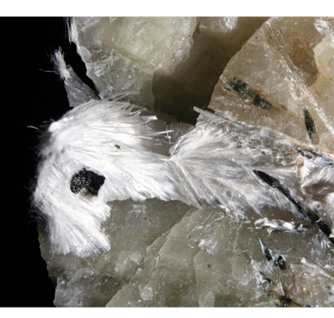
Masses or cluster of very
thin hexagonal fibers. |
|
| |
|
| Physical
properties: |
|
| |
Cleavage: unknown.
Hardness: 4 - 5.
Density: 2.14 gm/cm3.
Luster: vitreous.
Streak: white. |
|
| |
Perialite crystals from Loparskaya Valley, Yukspor
Mt, Khibiny Massif, Murmansk Oblast, Russia. Field of view 10 mm.
Zeolite Collection of Volker Betz. Copyright: © Volker Betz (2008) |
| Optical
properties: |
|
| |
Color: colorless to gray.
Uniaxial (+). ω 1.479 – 1.483, ε 1.488 – 1.489, δ 0.005 – 0.010 |
|
| |
|
| Crystallography: |
|
| |
Unit cell
data:
a 18.490 - 18.543, c 7.51 - 7.531
Z = 1, Space Group P6/mmm (Artioli and Kvick
1990) |
|
| |
|
| |
|
| |
|
|
|
| Name: |
|
| |
Perlialite was named by
Men’shikov (1984) in honor of Lily Alekseevna Perekrest, instructor
of mineralogy at the Kirov Mining School. The type locality is at
Mt. Yukspor, Khibina massif, Kola Peninsula, Russia. |
| |
|
|
|
| Crystal structure: |
|
| |
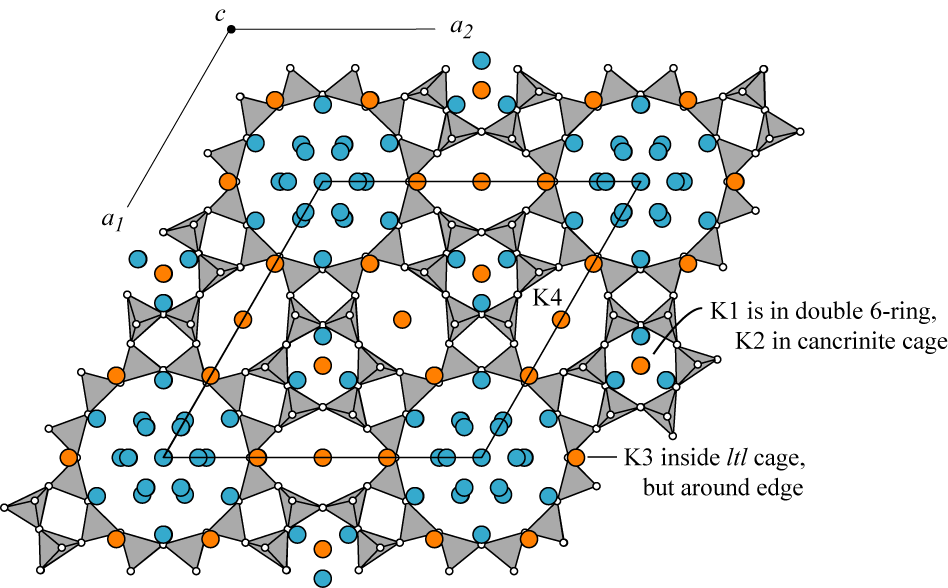
The framework topology
(Artioli and Kvick 1990) is the same as for synthetic Linde Type L (LTL)
as determined by Barrer and Villiger (1969). Two types of channels
run parallel to the c-axis. One is bounded by
twelve-membered rings of the ltl cages (aperture 7.1 Å),
and the other is bounded by strongly compressed eight-membered rings
(aperture 3.4 x 5.6 Å). T-O distances give no indication of (Si,Al)
order. When comparing the structural diagrams for mazzite
and perlialite projected to the c-axis, strong similarities are
evident. However, in perlialite six-membered double-rings connect
the sheets, whereas single rings occur in mazzite. Thus, in
perlialite six-membered rings (double 6-rings) connect two
cancrinite-type cages (LTL),
and in mazzite six-membered rings connect two gmelinite cages. |
| |
The powder sample used for
structure refinement (Artioli and Kvick 1990) was separated with
thallium malonate heavy liquid. Thus, perlialite became partly
ion-exchanged and approached the composition K8Tl4[Al2Si24O72]•20H2O.
K was located in the cancrinite cage (fully occupied) and in the
center of the six-membered double rings (occupancy 20%). Cations in
the large channels bonded to the six framework oxygens of the
eight-membered rings and additional H2O molecules which
fill the interior of the twelve-membered ring channels. |
 |
| |
Notice the
different arrangement of cations and H2O in the wide
channels compared with mazzite. The second most preferred
non-framework site (fully occupied) is in the compressed
eight-membered rings, forming channels parallel to the c-axis.
The temperature-induced structural changes in the synthetic counterpart
of perlialite was investigated by Gigli et al. (2013) and Precisvalle et al. (2023).
Strong pressure-induced over-hydration is observed when compressed in penetrating
pressure transmitting media (Gigli et al. 2019). |
| |
|
| Chemical composition: |
| |
Analyses of perlialite
from the two localities have similar compositions. TSi is
0.675 and 0.650, K is about 9 cations per unit cell, and Na about
one per unit cell. Ca, Mg, Ba, and Sr varying considerably, but
appear to occupy one cation site per unit cell. Synthetic Zeolite L
typically has the composition K9Na3Al9Si27O72•21H2O
(Barrer and Villiger 1969) The H2O content shows some
variation between the two samples, 9.52 and 11.0 weight percent,
which may be expected from the disorder in the ltl cages. |
| |
|
| Occurrences: |
| |
There are presently two
known occurrences of perlialite, and both are associated with
pegmatite dikes in alkaline massifs in Russia. At Mt. Eveslogchorr
and Mt. Yukspor in the Khibiny massif, Kola Peninsula perlialite is
in nepheline-microcline and sodalite-microcline cataclastic
pegmatoid veins, where it is associated with pectolite, kalsilite,
aegerine, wadeite, and yuksporite (Men’shikov 1984, Khomyakov 1995).
Perlialite occurs as white, fibrous vein fillings at Chioiny, Kola
Peninsula (Tschernich 1992) and at the Murun massif, Transbaikalia
(Konev et al. 1986). |
| |
|
| References: |
| |
Artioli, G. and Kvick, Å.
(1990) Synchrotron X-ray Rietveld study of perlialite, the natural
counterpart of syntheic zeolite-L. Eur. J. Mineral. 2,
749-759.
Barrer, R.M. and Villiger, H. (1969) The crystal structure of the
synthetic zeolite L. Z. Kristallogr. 128, 352-370.
Gigli, L., Arletti, R., Quartieri, S., Di Renzo, F. and Vezzalini,
G. (2013) The high thermal stability of the synthetic zeolite K–L:
Dehydration mechanism by in situ SR-XRPD experiments. Microporous
mesoporous mater., 177, 8-16.
Gigli, L., Vezzalini, G., Quartieri, S. and Arletti, R. (2019)
Compressibility behavior and pressure-induced over-hydration of zeolite
KAlSi-L. Microporous mesoporous mater. 276, 160-166.
Khomyakov, A.P. (1995) Mineralogy of hyperagpaitic alkaline
rocks. Clarendon Press, Oxford. 223 pp.
Konev, A.A., Sapozhnikov, A.N., Afonia, G.G., Vorob’ev, E.I.,
Arsenyuk, M.I., and Lapides, I.L. (1986) Perlialite from the Murun
Alkaline Massif. Zap. Vses. Mineral. Obshchest. 115,
200-204.
Men’shikov, Yu.P. (1984) Perlialite, K9Na(Ca,Sr)[Al
12Si24O72]•15H2O,
a new potassium zeolite from the Khibina Massif. Zap. Vses.
Mineral. Obshchest. 113, 607-612.
Precisvalle, N., Beltrami, G., Ardit, M., Giacobbe, C., Pasti, L.,
Chenet, T. and Martucci, A. (2023) Temperature-Induced Structural
Changes in Acidic L-Zeolite: An In Situ Synchrotron Time-Resolved
Powder Diffraction Study. J. Phys. Chem., 127(27), 13276-13285.
Tschernich, R.W. (1992) Zeolites of the World, Geoscience
Press, Phoenix, Arizona. 563 pp.
Updated: November 2025.
|