| Pahasapaite | |(Ca5.5Li3.6K1.2Na0.2)Li8 ( H2O)38| [Be24P24O96] | |||
| Morphology: | ||||
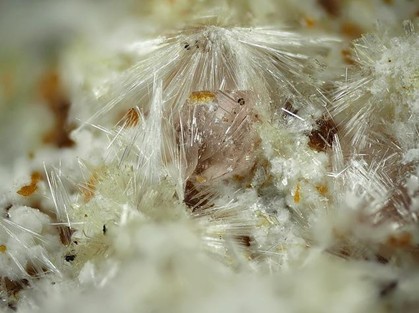
| Isometric, equant, somewhat malformed dodecahedra about 1.0 mm in diameter. | ||||
| Physical properties: | ||||
| Cleavage: none. Hardness: 4.5. Density: 2.28 gm/cm3. Luster: vitreous. Streak: white. |
![]() |
|||
| Optical properties: | ||||
| Color: Colorless to light
pink. Isotropic. n = 1.523 |
||||
| |
Tip Top Mine, Fourmile, Custer Mining District, Custer County, South Dakota, USA © Thomas Witzke / Abraxas-Verlag. | |||
| Crystallography: | ||||
| Unit cell
data: a 13.781 Å, Z = 1, Space group I23. (Rouse et al. 1987) |
||||
| Name: | ||||
| Pahasapaite is found with other secondary beryllium-phosphate minerals in fractured beryl crystals at the Tip Top Mine, Black Hills, South Dakota, U.S.A., and was described and named by Rouse et al. (1987) after the Lakota Sioux word for the Black Hills, Pahasapa. | ||||
| Crystal structure: | ||||
| The structure (Rouse et al. 1989) contains ordered BeO4 and PO4 tetrahedra forming a three dimensional array of distorted truncated cubo-octahedra or α-cages (see RHO and the drawing) connected via double eight-membered rings (aperature 2.2 x 2.2 Å). There are two identical, interpenetrating systems of cages related by the I-centering of the lattice. Similar α-cages also exist in paulingite. Pahasapaite has a distorted zeolite rho framework. The wide cages have a diameter of about 8 Å. Hydrated zeolite rho has the maximum symmetry Im3m, which is reduced to I43m in dehydrated zeolite rho and to I23 in pahasapaite due to (Be,P) ordering. Eight Li and 32 H2O molecules reside within the cages. The remaining six H2O molecules and 10.5 cations block the passages of double eight-rings between two cages. When pahasapaite is dehydrated (Corbin et al. 1991), the unit-cell volume decreases by 14% due to H2O loss and increases for the dehydrated form by ~1% between 25°C and 400°C (Parise et al. 1994). Under compression, a transformation from centric (Im-3m) to acentric (I-43m) form was observed at P−0.5 GPa (Lee et al. 2001). The exchanged RHO-zeolites show cation-specific P-responses, dictated by complex sorption mechanisms of the penetrating P-transmitting media. | ||||
![]() |
||||
| Chemical composition: | ||||
| (Ca5.5Li3.6 K1.2,Na0.2□13.5)Li8Be2 P24O96•38H2O, where □ represents a vacancy. | ||||
| Occurrences: | ||||
| Pahasapaite is only known from the Tip Top Pegmatite, Black Hills, Custer County, South Dakota. Most secondary phosphate minerals are found in the inner-intermediate zone of a perthite-quartz-triphyllite pegmatite with accessory beryl, fluorapatite, and columbite-tantalite (Campbell and Roberts 1986). Pahasapaite and other beryllophosphate minerals are largely restricted to fractures in beryl. | ||||
| References: | ||||
| Campbell, T.J. and
Roberts, W.L. (1986) Phosphate minerals from the Tip Top Mine,
Black, Hills, South Dakota. Mineral. Rec. 17, 237-254. Corbin, D.R., Abrams, L., Jones, G.A., Harlow, R.L., and Dunn, (.J. (1991) Flexibility of the zeolite rho framework: Effect of dehydration on the crystal structure of the beryllophosphate mineral pahasapaite. Zeolites, 11, 364-367. Lee, Y., Hriljac, J.A., Vogt, T., Parise, J.B., Edmondson, M.J., Anderson, P.A., Corbin, D.R. and Nagai, T. (2001) Phase transition of zeolite RHO at high-pressure. J. Am. Chem. Soc., 123(34), 8418-8419. Parise, J.B., Corbin, D.R., Abrams, L., Northrup, P., Rakovan, J., Nenoff, T.M., Stucky, G.D. (1994) Structural relationships among some BePO-, BeAsO-, and AlSiO-rho frameworks. Zeolites. 14, 25-34. Rouse, R.C., Peacor, D.R., Dunn, P.J., Campbell, T.J., Roberts, W.L., Wicks, F.J., and Newbury, D. (1987) Pahasapaite, a beryllophosphate zeolite related to synthetic zeolite rho, from the Tip Top Pegmatite of South Dakota. Neues Jahrb. Miner. Monatsh. 1987, 433-440. Rouse, R.C., Peacor, D.R., and Merlino, S. (1989) Crystal structure of pahasapaite, a beryllophosphate mineral with a distorted rho framework. Am. Mineral., 74, 1195-1202. Updated: October 2025. |
||||