| Mazzite Series |
Mazzite-Mg |(Mg2.5K2Ca1.5)
(H2O)30| [Al10Si26O72] |
||
| Morphology: | |||
| Hexagonal, prismatic to finely fibrous, radiating aggregates. | ![]() |
||
| Physical properties: | |||
|
Cleavage: none. |
|||
| Optical properties: | |||
|
Color: colorless. Mazzite-Na Uniaxial (+). α 1.472, γ 1.471, δ 0.001 |
|||
| Spray of Mazzite-Mg fibers with phillipsite and stubby offretite prisms, Mont Semiol, Montbrison, France. Field of view, 2.5 mm. © Volker Betz | |||
| Crystallography: | |||
| Unit cell data | |||
| Mazzite-Mg | a 18.392, c 7.646 Å Z = 1, Space group P63/mmc. (Galli 1975) |
||
| Mazzite-Na | a 18.2343(7), c 7.6371(2) Å Z = 1, Space group P63/mmc. (Arletti et al. 2005) |
||
| Names: | |||
| Mazzite from outcrops of olivine basalt near the top of Mont Semiol, near Montbrison, Loire, France, was described and named by Galli et al. (1974) to honor Fiorenzo Mazzi, Professor of Mineralogy at the University of Pavia, Italy. Sodium-rich mazzite from Boron, California, USA, was described and named mazzite-Na by Arletti et al. (2005). With the approval of the Commission on New Minerals, Nomenclature and Classification of the Internal Mineralogical Association the name mazzite was raised to series status and the original mazzite was renamed mazzite-Mg. | |||
| Crystal structure: | |||
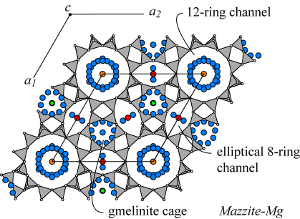
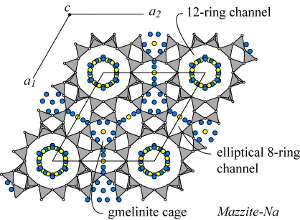
| Mazzite is closely related to the molecular sieve Ω, which was first described in Union Carbide Dutch Patent (1967). The framework of mazzite consists of edge-sharing four-ring chains that have the sequence of two tetrahedral apices up and one down (see dsc on the MAZ page), which link into a hexagonal structure. Two types of channels run parallel to the c-axis. One is confined by twelve-membered rings of tetrahedra (aperture 7.4 Å), the other by elliptical eight-membered rings (aperture 5.6 x 3.4 Å). T-O distances are consistent with (Si, Al) disorder. | |||
| In mazzite-Mg the Mg occurs in “gmelinite-type” cages (see gme on the MAZ page) and is six-coordinated by H2O molecules. Galli (1975) speculated that the Mg-H2O complex acts as a template for the formation of “gmelinite-type” cages. An additional cation site (occupancy about 50%) is mainly occupied by K (red in the figure) and is situated in the distorted eight-membered rings, where it is octahedrally coordinated by four framework oxygens and two H2O molecules. Ca is located in the center of the large channels, running parallel to the c-axis and is surrounded by disordered H2O molecules. The walls of these large channels are lined with H2O molecules, and the cations sit at regular intervals in the middle of these H2O pipes (Galli 1975). | ![]() |
||
| Dehydration of mazzite
and accompanying cation diffusion was investigated by Rinaldi et
al (1975) and Alberti and Vezzalini (1981). In mazzite-Na the only cations are Na (yellow), which are located at three different sites (Arletti et al. 2005). NaI is at the center of the 6-membered ring between adjacent gmelinite cages and is coordinated by six framework oxygens and two H2O molecules. NaII lies on the centerline of the elliptical 8-membered ring channel and is coordinated by four framework oxygens and two H2O molecules. NaIII occupies sites with H2O along the walls of the 12-membered ring channel, and is coordinated with two framework oxygen atoms and four H2O molecules. |
![]() |
||