| Lovdarite | |K4 Na12 (H2O)18| [Be8Si28O72] | ||
| Morphology: | |||
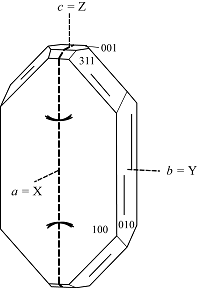
| Occurs as platy, rectangular crystals in sheaves or clusters. Common crystal forms: {100},{201}, {311}, {001}, and {010}. | ![]() |
||
| Physical properties: | |||
| Cleavage: {100} good,
{010} and {001} distinct. Hardness: 5 - 6. Density = 2.33 gm/cm3. Luster: vitreous. Streak: white. Fluorescence: strong green fluorescence in short-wave, UV light. |
|||
| Optical properties: | |||
|
Color: colorless; colorless in thin section. |
|||
| Crystallography: | |||
| Unit cell
data: a 39.576, b 6.931, c 7.153 Å. Z = 1, Space group Pma2 (Merlino 1990). |
|||
| Name: | |||
| Lovdarite was named by Men’shikov et al. (1973) for a bladed mineral replacing chkalovite in pegmatitic rocks on Mount Karnasurt in the Lovozero pluton, Kola Peninsula, Russia. The name is from the Russian phrase “dar Lovozera” meaning “a gift of Lovozero”. | |||
| Crystal structure: | |||
| The structure (Merlino 1981, 1990) consists of a framework (LOV) of ordered Si and Be tetrahedra in chains of polyhedra connected by 3-rings, which contain the Be tetrahedral sites. These chains are linked by 4-rings to form a sheet with 8-ring windows. Successive sheets are rotated 90° around the a-axis and are linked by sharing the outer T-site of the 3-rings. These linkages form a unique group of five tetrahedra in two 3-rings, spiro-5, comprising two BeO4 (dark gray) and three SiO4 (light gray) tetrahedra (see the accompanying diagram). | |||
![]() |
|||
| The resulting structure has channels running parallel to the a-axis through the eight-membered rings (aperture 3.6 x 3.7 Å) and running parallel to the b-axis through strongly deformed nine-membered rings (aperture 3.2 x 4.4 Å). (See diagram). There are four Na sites (yellow circles) which are bonded to the framework oxygens that are shared by Si and Be tetrahedra. Na1 and Na2 are located within the 8-ring windows of the sheets that have spiro-5 chains parallel to the b-axis, and Na4 is similarly located in the 8-ring windows of the sheets that have spiro-5chains parallel to the c-axis. Na3 and K (red) sites are in the intersheet channels. One or two water molecules are coordinated with each cation. Diffraction patterns suggest that lovdarite may consist of distinct disordered domains (Merlino 1990). | |||
| Chemical composition: | |||
| The analyses of lovdarite from the type area and from the Greenland occurrence show minor differences in composition. Minor amounts of Al appear to replace Si, but not Be, and TSi is between 0.75 and 0.78 in these samples. Na and K are the predominant non-framework cations. | |||
| Occurrences: | |||
| Lovdarite is presently known from a few localities, where it is a late stage mineral in alkalic intrusive rocks. In the type locality it is a hydrothermal alteration mineral in a pegmatoid unit between lujavrite and fayaite of an alkalic intrusion on Mount Karnasurt in the Lovozero pluton, Kola Peninsula. Lovdarite forms reaction rims up to 2 cm wide on large chkalovite crystals embedded in natrolite (Men’shikov et al. 1973). It has recently been identified in tugtupite-bearing albitite on the Kvanefjeld Plateau in the Ilimassaq complex of South Greenland (Peterson et al. 2002). Here lovdarite occurs in association with aegerine, albite, analcime, episolite, neptunite, and others. Lovdarite also occurs as a miarolitic cavity mineral in the phonolite sill at Point of Rocks, Colfax County, New Mexico, USA (DeMark 1989). This lovdarite occurs as twinned tabular crystals in clusters about 1 mm across, and is associated with albite, aegerine, mangan-neptunite, and analcime. Recent studies report new occurrences from Khomas Region, Namibia (Blaß et al. 2016) and Canary Islands, Spain (Dill et al. 2023). | |||
| References: | |||
|
Blaß, G., Kolitsch, U., Tremmel, G. and Esche, J. (2016): Neue Mineralienfunde aus den Phonolithbrüchen von Aris in Namibia. Mineralien-Welt 27 (4), 48-60 (in German). Dill, H.G. and Rüsenberg, K.A. (2023) Marker Minerals in Volcanics and Xenoliths—An Approach to Categorize the Inferred Magmatic Rocks Underneath the Present-Day Volcanic Landscape of Tenerife, Spain (NW African Rare Mineral Province). Minerals, 13, 1410. DeMark, R.S. (1989) Micromounting in New Mexico. Mineral. Record, 20, 57-64. Men’shikov, Y.P., Denisov, A.P., Uspenskaya, Y.I., and Lipatova, E.A. (1973) Lovdarite, a new hydrous beryllosilicate of alkalies. Doklady Acad. Nauk SSSR, 213 429-432. Merlino, S. (1981) Lovdarite: three-membered rings in a framework silicate. Acta. Crystallog. A37 suppl., C-189. Merlino, S. (1990) Lovdarite, K4Na12(Be8 Si28O72)•18H2O, a zeolite-like mineral: structural features and OD character. Eur. J. Mineral., 2, 809-817. Peterson, O.V., Niedermayr, G., Johnsen, O., Gault, R.A. and Brandstatter, F. (2002) Lovdarite from the Ilimaussaq alkaline complex. South Greenland. Neues Jahrb. Miner. Monatsh. 2002, 23-30. Updated: August 2025. |
|||