Cleavage: absent
Hardness: 3½ - 4 on Mohs scale
Density = 3.46(5) gm/cm3 (Measured) 3.512 gm/cm3 (Calculated)
Luster: vitreous, silky
Streak: white
Color: murky white in transmitted light, transparent with white streak and silky to vitreous lustre.
Biaxial (+)
α = 1.579(5), β = 1.591(5), γ = 1.606(5) (white light), 2V (meas.) = 82(2)° and 2V (calc.) = 85°. It is non-pleochroic under polarised light,
with a very weak (r > v) dispersion.
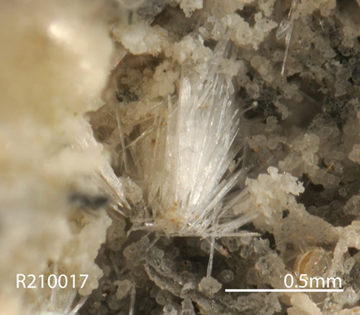
Loomisite crystals from the Big Chief Mine, Glendale, Keystone Mining District, Pennington County, South Dakota, USA (Source: mindat.org).
Unit cell: a 7.629, b 9.429, c
4.762 Å, β 91.27°
Z = 2. Space group: Pn
(Yang et al. 2023)
Named after Tom Loomis, mineral collector and dealer from South Dakota, USA, who collected the type material.
The crystal structure of loomisite is characterised by a framework of corner-sharing PO4 and BeO4 tetrahedra, with a topology identical to that of the zeolite ABW type. The framework can be considered as built from the stacking of sheets consisting of 4- and 8-membered rings (4.82 nets) along [001] (Fig. 1a) or hexagonal layers (63 nets) along [010] (Fig. 1b). The extra-framework Ba2+ and H2O are situated in the channels formed by the 8-membered rings. As in other framework beryllophosphates, every framework O atom in loomisite is bonded to one P and one Be, giving rise to an ordered arrangement of P and Be atoms in the framework. Any linkages of P–O–P or Be–O–Be are strictly forbidden because they would make bridging O atoms either over-bonded or under-bonded.
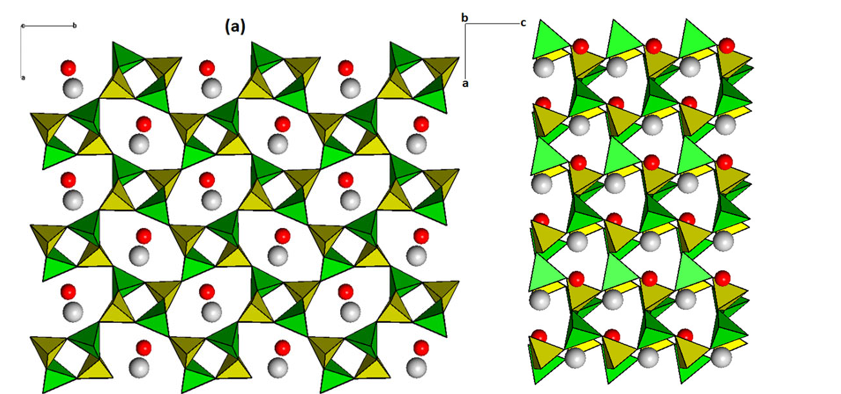
Loomisite structure. The beryllophosphate framework is shown in green and yellow. The extra-framework Ba atoms are in grey and the H2O molecules in red (From Yang et al., 2023).
An electron microprobe analysis, along with the BeO content measured with an ICP-MS, yields an empirical formula (based on 9 O apfu) (Ba0.96Ca0.06) Σ1.02[(Be1.96Fe0.06)Σ2.02P1.99 O8] · H2O, which can be simplified to (Ba,Ca)[(Be,Fe)2P2 O8] · H2O.
Loomisite was found on specimens collected from the Big Chief mine (43°51’54’’N, 103°22’54’’W), near Keystone, Pennington County, South Dakota, USA. Associated minerals on the type sample include dondoellite Ca2Fe(PO4)2 · 2H2O, earlshannonite Mn2+Fe3+2 (PO4)2(OH)2 · 4H2O, mitridatite Ca2Fe3+O2(PO4)3 · 3H2O, rockbridgeite (Fe2+0.5Fe3+0.5) 2Fe3+3(PO4)3(OH)5, jahnsite-(CaMnFe) CaMn2+Fe2+2 Fe3+2 (PO4)4(OH)2 · 8H2O, and quartz. On a larger scale, loomisite was found in a boulder containing ludlamite Fe2+(PO4)2 · 4H2O, vivianite Fe2+(PO4)2 · 8H2O, and, to a lesser extent, phosphoferrite Fe2+3 (PO4)2 · 3H2O, perloffite BaMn2+2 Fe3+2 (PO4)3 (OH)3, and kryzhanovskite (Fe3+,Mn2+)3(PO4)2 (OH,H2O3.
Yang, H., Gu, X., Gibbs, R. B. and Downs, R. T. (2023) Loomisite, Ba[Be2P2O8]· H2O, the first natural example with the zeolite ABW-type framework, from Keystone, Pennington County, South Dakota, USA. Mineral. Mag.. 87(1), 79-85.
Updated: May 2025.