| |
|
| Gobbinsite |
|(Na, Ca0.5)6
(H2O)12| [Al6Si10O32]
|
| |
|
|
|
| Morphology: |
|
|
| |
Compact masses up to 2 cm,
consisting of finely fibrous crystals, or wedge-shaped crystals. |
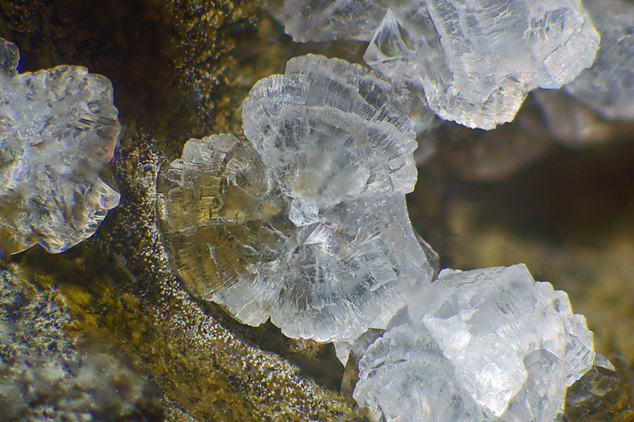 Gobbinsite crystals from Poudrette quarry, Mont
Saint-Hilaire, La Vallée-du-Richelieu RCM, Montérégie, Québec,
Canada Gobbinsite crystals from Poudrette quarry, Mont
Saint-Hilaire, La Vallée-du-Richelieu RCM, Montérégie, Québec,
Canada
|
|
| |
|
| Physical
properties: |
|
| |
Cleavage: none.
Fracture: brittle uneven.
Hardness: 4.5 - 5.
Density = 2.13 - 2.17 gm/cm3.
Luster: vitreous.
Streak: white. |
|
| |
|
| Optical
properties: |
|
| |
Color: Chalky white to
light brown; colorless in thin section.
Uniaxial (-) or biaxial. ω 1.494, ε 1.489, δ 0.005 |
|
| |
|
| Crystallography: |
|
| |
Unit cell
data:
a 10.1035, b 9.7819 c 10.1523 Å
Z = 1, Space group Pmnb (Gatta et al. 2010) |
|
| |
|
| |
|
| |
|
|
|
| Name: |
|
| |
Gobbinsite was named by
Nawaz and Malone (1982) for the type locality, which is in basalt
cliffs near Hills Port, south of the Gobbins area, County Antrim,
Northern Ireland. |
| |
|
|
|
| Crystal structure: |
|
| |
The gobbinsite has the
same framework topology as gismondine, which consists of two sets of
intersecting, doubly connected 4-membered rings linked into double
crankshaft chains (dcc on the GIS page). These sets of double crankshaft
chains that run parallel to the a-axis and the b-axis
are related by a pseudo-41 axis parallel to the c-axis.
Gobbinsite is the natural counterpart of the synthetic zeolite Na-P2
(Hansen et al. 1990). The structure of gobbinsite is
equivalent to garronite-Na (Skrzynska et al. 2023).
|
| |
Because most gobbinsite
occurs in masses of fibrous crystals so thin, none have been
suitable for single crystal X-ray analysis. The structure of
material was refined by the Rietveld technique by McCusker et
al. (1985) and Artioli and Foy (1994) in the space group Pmn21.
Gatta et al. (2010) refined the structure of crystals from
near Victoria, Australia, by single crystal X-ray diffraction in the
space group Pmnb. The framework is highly disordered. In
the channels parallel to the a-axis Na (yellow) is
coordinated with four framework oxygens and two H2O
molecules and Ca (orange is coordinated with five framework oxygens
and two H2O molecules. Low-T study shows a significant
rearrangement of the extra-framework configuration of gobbinsite
(Gatta and Lotti 2011). Partial ordering of H2O and onset
of new deformational modes occur at high-P (Gatta et al.
2012). |
 |
| |
|
| Chemical composition: |
| |
In the few known
gobbinsite samples that have been analyzed, the cation content is
somewhat variable, but Na greatly predominates with Ca less than 0.6
atoms per unit cell. High K contents (greater than 0.1 atom per unit
cell) is likely to be from intergrown phillipsite. All four analyzed
gobbinsite samples have 10.4 Si or less per unit cell. The H2O
content is likely to be approximately 17 weight per cent, which
corresponds to 12 H2O molecules per unit cell (Deer et
al. 2004, and Gatta et al. 2010). |
| |
|
| Occurrences: |
| |
The type specimen was
found in basalt cavities on Island Magee, Northern Ireland (Nawaz
and Malone 1982). Walker (1962) suggests sea water in place of the
usual meteoric water was responsible for the crystallization of the
sodic zeolites or may have caused later alteration of garronite to
gobbinsite. Gobbinsite occurs as fibrous crystals in amygdules of
altered trachybasalt at Kuniga, Dozen, Oki Islands, Shimane
Prefecture, Japan (Matsuyama and Matsubara 2000), where it is
associated with cowlesite and levyne. It occurs as glassy,
wedge-shaped crystals in a basalt quarry (Boral Quarry) at Bundoora,
a northern suburb of Melbourne, Victoria, Australia, associated with
chabazite-Na, phillipsite-Na, gonnardite, natrolite, and
thomsonite-Ca (Gatta et al. 2010).
Gobbinsite has also been found in a eudialyte pegmatitic lens in the
nepheline syenite, exposed in the Poudrette Quarry, Mont
Saint-Hilaire, Quebec (Horvath and Gault 1990). |
| |
|
| References: |
| |
Artioli, G. and Foy, H.
(1994) Gobbinsite from Magheramorne quarry, Northern Ireland. Mineral.
Mag. 58, 615-620.
Deer, A., Howie, R., Wise, W.S., and Zussman, J. (2004) Rock
Forming Minerals. vol. 4B. Framework Silicates: Silica Minerals,
Feldspathoids and the Zeolites. The Geological Society,
London.
Gatta, G.D., Birch, W.D., Rotiroti, N. (2010) Reinvestigation of the
crystal structure of the zeolite gobbinsite: A single-crystal X-ray
diffraction study. Am. Mineral. 95, 481-486.
Gatta, G.D. and Lotti, P. (2011) On the low-temperature behavior of
the zeolite gobbinsite: A single-crystal X-ray diffraction study. Microporous
mesoporous mater., 143(2-3), 467-476.
Gatta, G.D., Lotti, P., Nestola, F. and Pasqual, D., (2012) On the
high-pressure behavior of gobbinsite, the natural counterpart of the
synthetic zeolite Na–P2. Microporous Mesoporous Mater.,
163, 259-269.
Hansen, S., Håkansson, U. and Fälth, L. (1990) Structure of
synthetic zeolite Na-P2. Acta Cryst. C, 46(8), 1361-1362.
Horvath, L and Gault, R.A. (1990) The mineralogy of Mont
Saint-Hilaire Quebec. Mineral. Record. 21, 284-359.
Matsuyama, F. and Matsubara, S. (2000) Gobbinsite from Kuniga,
Dozen, Oki Islands, Shimane Prefecture, Japan. Japan.
Mag. Mineral. Petrol. Sci. 29, 129-135.
McCusker, L.B., Baerlocher, C. and Nawaz, R. (1985) Rietveld
refinement of the crystal structure of the new zeolite mineral
gobbinsite. Z. Kristallogr. 115, 439-450.
Nawaz, R. and Malone, J.F. (1982) Gobbinsite, a new zeolite mineral
from Co. Antrim, N. Ireland. Mineral. Mag. 46, 365-369.
Skrzynska, K., Cametti, G., Juroszek, R., Schafer, C. and Galuskina,
I. (2023) New data on minerals with the GIS framework-type
structure: gismondine-Sr from the Bellerberg volcano, Germany, and
amicite and Ba-rich gismondine from the Hatrurim Complex, Israel. Mineral.
Mag., 87(3), 443-454.
Walker, G.P.L. (1962) Garronite, a new zeolite, from Ireland and
Iceland. Mineral. Mag. 33, 173-186.
Updated: June 2025.
|