| |
|
| Gaultite |
Na4 (H2O)5|
[Zn2Si7O18] |
| |
|
|
|
| Morphology: |
|
|
| |
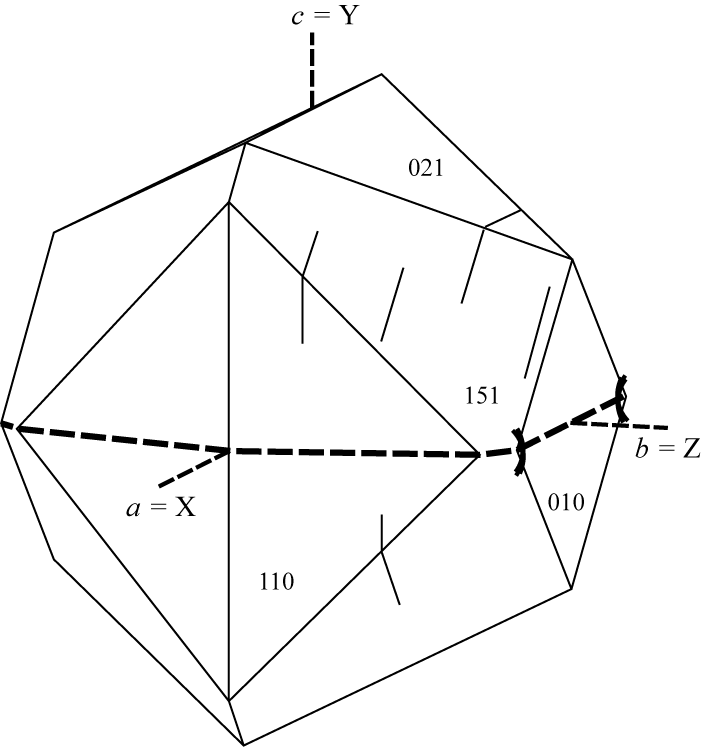
Equant, euhedral crystals
are small, about 0.5 mm, multifaceted with the {110}, {021}, {010},
{151}. |
| |
|
| Physical
properties: |
|
| |
Cleavage: {101} and {010}
perfect.
Hardness: 6.
D = 2.52 gm/cm3.
Luster: vitreous.
Streak: white.
Fluorescence: strong bright apple-green under short wave UV light. |
 |
| |
| Optical
properties: |
| |
Color: colorless,
pale-mauve.
Biaxial (+). α = 1.520, β = 1.521, γ = 1.524, δ = 0.004, 2Vz =
61°. Dispersion: r > v weak to moderate.
X = a, Y = c, Z = b |
| |
| Crystallography: |
| |
Unit cell
data:
a 10.211, b 39.88, c 10.304 Å.
Z = 8, Space group F2dd (Ercit and Van
Velthuizen, 1994). |
| |
|
| |
|
| |
|
|
|
| Name: |
|
| |
Gaultite was described and
named by Ercit and Van Velthuizen (1994) for Robert Allen Gault of
the Canadian Museum of Nature, Ottawa, Ontario, for his many
contributions to the mineralogy of Mont Saint-Hilaire. The type
locality is the Poudrette Quarry, Mont Saint-Hilaire, Quebec,
Canada. It is the natural occurrence of the synthetic zeolite VPI-7
(Annen et al. 1991). |
| |
|
|
|
| Crystal structure: |
|
| |
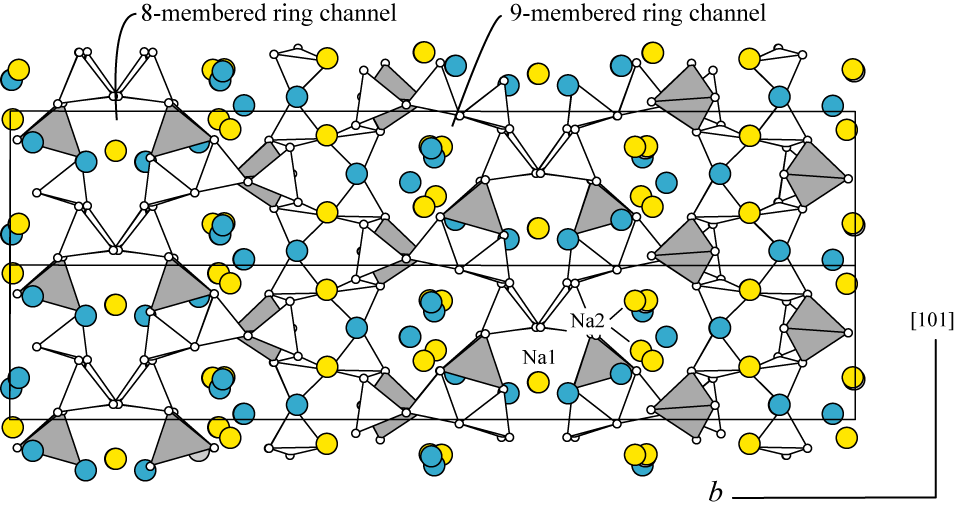
Gaultite has a framework
structure (VSV)
consisting of ordered ZnO4 and SiO4 tetrahedra
forming strongly deformed eight- and nine-membered ring channels
along [101] (Ercit and Van Velthuizen 1994). The eight-membered ring
channel is filled with chains of edge-sharing NaO6 octahedra built
by framework oxygen atoms and H2O molecules. The nine-membered
ring channels host disordered Na (yellow) and H2O (blue).
The framework can be constructed from stacks along b of
two-dimensional nets composed of four- and eight-membered rings with
periodic insertions of tetrahedra between the sheets. The framework
also has characteristic three membered rings formed by two SiO4
and on ZnO4 tetrahedra. |
| |
 |
| |
|
| Chemical composition: |
| |
The only analysis for gaultite
is in Ercit and Van Velthuizen (1994). The empirical formula is
Na4.28Zn1.88Si6.99O18 · 5H2O
which, considered with structural data, gives the ideal formula
Na4Zn2Si7O18·5H2O (Z = 8).
|
| Occurrences: |
| |
The only known occurrence
of gaultite was in a cavity of a large (12 m3) sodalite syenite
inclusion within nepheline-sodalite syenite at the Poudrette Quarry,
Mont Saint-Hilaire, Rouville County, Quebec, Canada (Ercit and Van
Velthuizen 1994). Gaultite is a product of late stage fluid
activity, as it crystallized after other late stage zeolites and
feldspathoids, including analcime, cancrinite, chabazite,
natrolite, phillipsite, and sodalite. From the synthesis conditions
of VPI-7, gaultite may have formed at similar temperatures (about
200°C). |
| |
|
| References: |
| |
Annen, M.J., Davis, M.E.,
Higgins, J.B. and Schlenker, J.L. (1991) VPI-7: the first
zincosilicate molecular sieve containing three-membered T-atom
rings. J. Chem. Soc., Chem. Commun. 1991,
1175-1176.
Ercit, T.S. and Van Velthuizen, J. (1994) Gaultite, a new
zeolite-like mineral species from Mont Saint-Hilaire, Quebec, and
its crystal structure. Can. Mineral. 32,
855-863.
Updated: June 2025. |