Dachiardite-Ca |( Ca0.5,Na,K)5(H2O)13|[Al5 Si19 O48]
Dachiardite-Na |( Na,K,Ca0.5)4(H2O)13|[Al4 Si20 O48]
Dachiardite-K
|(K2, Ca)(H2O)13|[Al4
Si20 O48]
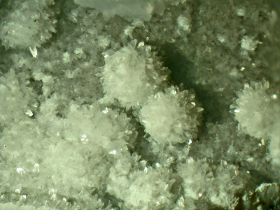
Monoclinic 2/m, bladed crystals elongated on [010] with the forms {001}, {100}, {-201} and {110}.
Cleavage: {100} and {001}
perfect.
Hardness: 4 – 4.5
D: dachiardite-Ca 2.14 – 2.21 gm/cm3
dachiardite-Na 2.14 – 2.17 gm/cm3
dachiardite-K 2.18
gm/cm3
Luster: vitreous.
Streak: white.
Color: Colorless, white, yellowish, pinkish, orange to red;
colorless in thin section
dachiardite-Ca: biaxial (+ ) α 1.488 – 1.494, β 1.490 – 1.496,
γ 1.494 – 1.499, δ 0.005 – 0.006, 2Vz 58° - 73°, X = b, Z ∧c
= 58° - 38°
dachiardite-Na : biaxial (+ or - ) α 1.471 – 1.480, β 1.475 –
1.481, γ 1.476 – 1.484, δ .005 – 0.006, 2Vz 55° - 142°, X = b, Z∧c
= 23° - 18°
dachiardite-K : biaxial (+ ) α 1.477, β 1.478, γ 1.481, δ 0.004,
2Vz 65°, X = b, YZ plane
coincides with a cleavage plane and the mineral shows straight
extinction in this plane.
dispersion: r > v,
moderate

Unit cell data:
dachiardite-Ca a 18.676, b 7.518, c
10.246 Å, β 107.87°.
Z = 1, Space group C2/m or Cm.
(Vezzalini 1984)
dachiardite-Na a 18.647, b 7.506, c
10.296 Å, β 108.37°
Z = 1, Space group C2/m or Cm.
(Alberti 1975)
dachiardite-K a 18.670, b
7.511, c 10.231 Å, β 107.79°.
Z = 1, Space group C2/m, Cm or C2. (Chukanov et al. 2016)
Dachiardite was described and named by D’Achiardi (1906) to honor his father Antonio D’Achiardi (1839-1902), the first full professor of Mineralogy at the University of Pisa. The type material comes from San Piero in Campo, Elba, Italy. Coombs et al. (1997) have elevated the name to series status to include two species. Dachiardite-Ca is the new name for the original material, in which Ca is the most abundant non-framework cation. Dachiardite-Na is a new species with the type example from Alpe di Suisi, Bolzano, Italy. Dachiardite-K occurs at Zvezdel, Momchilgrad Municipality, Kardzhali Province, Bulgaria.
Dachiardite species are monoclinic, space group C2/m,
Cm or C2. However, all
available structure refinements (Gottardi and Meier 1963,
Vezzalini 1984, Quartieri et al.
1990) have been performed in the higher space group C2/m. Vezzalini (1984) and Quartieri et al. (1990) detected two types of
domains, called A and B, in an equal ratio, resulting in the
average symmetry C2/m. These
two domains form to avoid energetically unfavorable 180° T-O-T
angles (e.g. Meier and Ha 1980, Gibbs 1982), similar to the
symmetry lowering in mordenite and epistilbite. Out of the few
occurrences of dachiardite (Tschernich 1992), only the samples
from Elba (Gottardi and Meier 1963, Vezzalini 1984) and from
Hokiya-dake, Japan (Quartieri et al.
1990) give sharp single-crystal X-ray reflections. All other
investigated samples yield diffuse peaks and streaking (Alberti
1975, Gellens et al. 1982)
caused by severe disorder and twinning. Actually, the mineral
“svetlozarite” proposed by Maleev (1976) was shown by Gellens et al. (1982) to be a twinned
dachiardite with stacking faults and twin domains only a few
unit-cell in size. Quartieri et al.
(1990) identified two types of dachiardite frameworks (normal
dachiardite and modified dachiardite) within the same crystal.
They assumed that alternating small domains of different size or
possibly a high density of stacking faults caused domain
formation.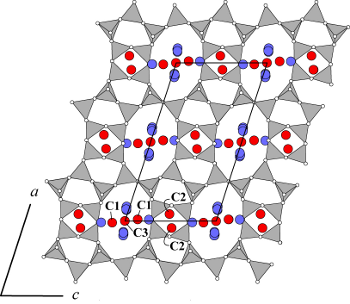
The dachiardite framework can be constructed from cross-linking slightly puckered sheets parallel to (100) formed by six-membered rings (for example, along the top of the figure below, also see DAC). Two of these sheets are linked parallel to the a-axis by four-membered rings. Thus, somewhat elliptical channels confined by ten-membered rings (aperture 5.3 x 3.4 Å) are formed parallel to the b-axis. These channels are additionally connected by channels through eight-membered rings (aperture 3.7 x 4.8 Å) running parallel to the c-axis. The structural difference between mordenite and dachiardite can best be envisioned by the arrangement of tetrahedra pointing up and down within the six-membered ring sheets. [Lynn: insert a hyperlink to our mordenite]
Cations (red) and H2O molecules (blue) are located in the channels. Cation sites C1 and C3 are at the intersections of the b and c channels along with the water molecules. The sites are too close for simultaneous occupancy. As a consequence in the Elba dachiardite-Ca C1 has an occupancy by Ca near 35%, while C3 was not found. The C2 sites (K) are in the c channel, in the 8-ring windows of the (001) sheet, and have an occupancy of about 15% (Vezzalini 1984). In the dachiardite-Ca from Hokiya-dake, Nagano, Japan, Quartieri et al. (1990) found that C1 was 32% occupied; C2 24%, and C3 14%.
Natural zeolites of the dachiardite solid solution series are characterized by widely variable contents of extraframework cations, especially those of Na and Ca. Mel’chakova et al. (2007) determined dachiardite-Na, Na4(Al4Si20O48) ·13H2O, dachiardite-K, K4(Al4Si20O48) ·13H2O, and dachiardite-Ca, Ca2(Al4Si20O48) ·13H2O as endmembers of this series and estimated their thermodynamic parameters.
The dachiardite series minerals are rare zeolites, occurring in diverse silica-rich environments. It is a late stage alteration mineral in pegmatite dikes on Elba, Italy; in a miarolitic cavity in the silicocarbonatite sill on Montreal Island, Quebec; in active hydrothermal systems of Yellowstone National Park, Wyoming; in hydrothermal veins of the Onoyama mine, Kagoshima, Japan; as joint coating in metamorphic rocks in the Tanzenberg Tunnel, Styria, Austria; and in cavities of lavas flows and pillow lavas of basaltic to andesitic composition. It is commonly associated with mordenite, ferrierite, clinoptilolite, and erionite. The following summary is adapted from Deer et al. (2004)
Diagenesis of lava flows.
There are scattered occurrences of dachiardite series minerals in
cavities of silica-saturated basaltic to andesitic lavas. Most are
described by Tschernich (1992). The following are descriptions of
those from which analyzed samples have been obtained.
Vesicles in the Columbia River Basalt exposed along the coast of Oregon and Washington, USA, contain abundant zeolites (Wise andTschernich 1978). In Oregon dachiardite-Ca occurs at Cape Lookout and Maxwell Point, Tillamook County, with clinoptilolite-Ca, mordenite, erionite-Ca, and phillipsite-K. At Yaquina Head, Agate Beach, Lincoln County, dachiardite-Na occurs with clinoptilolite. Dachiardite-Ca, mordenite, ferrierite-Na, and clinoptilolite-Ca fill the cavities at Altoona, Wahkiakum County, Washington. At all localities the host basalt is tholeiitic with a fine-grained to glassy groundmass. The flow has never been buried by sediment or other flows, but did interact with water (Pacific Ocean) during its emplacement. The zeolites may have formed as a result of this interaction during the initial cooling of the lava.
The type-example locality for dachiardite-Na is at Alpe di Suisi, Bolzano, Italy (Alberti 1975). Here radiating aggregates of dachiardite-Na blades, covered with red mordenite and calcite, fill cavities in breccia of porphyritic augite basalt with a glassy groundmass. It was also found in a similar occurrence in the same formation in the nearby Valle di Fassa (Demartin and Stolics 1979).
Two localities of dachiardite in altered lavas are on Chichijima Island, Japan. On the west coast at Susaki radial aggregates of dachiardite-Na fibers with mordenite and clinoptilolite occur in amygdules of altered andesite pillow lava (Nishido et al. 1979). At Hatsuneura on the east side of the island dachiardite-Ca occurs with mordenite and chalcedony in veins cutting altered boninite pillow lava (Nishido and Otsuka 1981). Dachiardite occurs in cavities of a sintered sandstone xenolith in the alkaline-olivine basalt at the Ortenberg Quarry, Vogelsberg, Hessen, Germany (Hentschel 1986).
Mordenite and clinoptilolite are common associated minerals, while ferrierite and erionite occur with dachardite in some localities. Minor alteration of host rocks suggest that the minerals were deposited from intrastratal fluids.
Hydrothermal alteration.
Active geothermal systems.
Dachiardite-Ca occurs in several zones of four drill cores, Y-2,
Y-3, Y-6, and Y-13, from the active thermal areas of Yellowstone
National Park, Wyoming (Bargar et al.
1987). In all drill holes the host rocks are rhyolite, and the
zeolite assemblages are generally silica-rich, but may be either
Ca- or Na-dominant. Dachiardite-Ca comes from intervals at depths
between 50 and 81 m, where the temperature is 150° to 170°C, and
water is mildly alkaline (pH about 8.5). Closely associated
minerals are mordenite, clinoptilolite, chalcedony or quartz, and
smectite.
Late stage, deuteric alteration. The crystals of dachiardite-Ca from the type occurrence in pegmatite dikes near San Piero in Campo on the island of Elba, Italy, are unique. They are prismatic and cyclically twinned on {110} into 8-lings, in the form of an “octagonal beaker” (Gottardi and Galli 1985; Orlandi and Scortecci 1985). Dachiardite-Ca occurs in late stage alteration cavities in pollucite and tourmaline-bearing pegmatite, accounting for the unusual Cs2O content (Bonardi 1979). Associated minerals in these cavities are mordenite, heulandite, epistilbite, and stilbite.
Dachiardite-Na was found in a single miarolitic cavity in the silicocarbonatite sill, exposed at the Francon quarry on Montreal Island, Quebec (Bonardi et al. 1981). It forms silky white acicular crystals in divergent fibrous bundles, 1 to 2 mm in length, and is associated with ankerite, calcite, weloganite, quartz, and mordenite on analcime coated cavity walls. Dachiardite-K occurs in the walls of opal–chalcedony veinlets cutting hydrothermally altered effusive rocks of the Zvezdel paleovolcanic complex near the village of Austa, Momchilgrad Municipality, Eastern Rhodopes, Bulgaria (Chukanov et al. 2016).
Fractures and cavities in granitic gneiss. Dachiardite-Na with mordenite and ferrierite occurs on joint surfaces and in cavities in chlorite schist and amphibolite in the tunnels through Tanzenberg near Kapfenberg, Styria, Austria (Postl et al. 1985). This type of occurrence in non-volcanic host rocks suggests the zeolite grew in warm fluids flowing through the fracture system.
Hydrothermal ore veins. In two localities in Japan dachiardite has been found in hydrothermal veins associated with epithermal ore deposits. Dachiardite-Ca with mordenite, heulandite (possibly clinoptilolite), and quartz occur in hydrothermal veins at the Onoyama Gold Mine, Kagoshima Prefecture (Kato 1973 and Nishido and Otsuka 1981). Associated with barite and sulfide minerals, dachiardite-Na occurs in veins cutting altered Miocene rhyolite at Tsugarwa, Niigata Prefecture (Yoshimura and Wakabayashi 1977 and Nishido and Otsuka 1981).
Alberti, A. (1975) Sodium-rich dachiardite from Alpe di Suisi, Italy. Contr. Miner. and Petr. 49, 63-66.
Bargar, K.E., Erd, R.C., Keith, T.E.C. and Beeson, M.H. (1987) Dachiardite from Yellowstone National Park, Wyoming. Can. Min., 25, 475-484.
Bonardi, M. (1979) Composition of type dachiardite from Elba. Min. Mag., 43. 548-549.
Bonardi, M., Roberts, A.C., Sabina, P., and Chao, G.Y. (1981) Sodium-rich dachiardite from the Francon Quarry, Montreal Island, Quebec. Can. Min., 19, 285-290.
Coombs, D.S., Alberti, A., Armbruster, T., Artioli, G., Colella, C., Galli, E., Grice, J.D., Liebau, F., Mandarino, J.A., Minato, H., Nickel, E.H., Passaglia, E., Peacor, D.R., Quartieri, S., Rinaldi, R., Ross, M., Sheppard, R.A., Tillmanns, E., and Vezzalini, G. (1997) Recommended nomenclature for zeolite minerals: Report of the Subcommittee on Zeolites of the International Mineralogical Association, Commission on New Minerals and Mineral Names. Can. Min., 35, 1571-1606.
Chukanov, N.V., Encheva, S., Petrov, P., Pekov, I.V., Belakovskiy, D.I., Britvin, S.N., Aksenov, S.M. (2016) Dachiardite-K, (K2Ca)(Al4Si20O48)·13H2O, a new zeolite from Eastern Rhodopes, Bulgaria. Geology of Ore Deposits, 58, 666-673.
D’Achardi, G. (1906) Zeoliti del filone della Speranza presso S. Piero in Campo (Elba). Atti Soc. Toscana Sci. Naturali , 22, 150-165.
Deer, A., Howie, R., Wise, W.S., and Zussman, J. (2004). Rock Forming Minerals. vol. 4B. Framework Silicates: Silica Minerals, Feldspathoids and the Zeolites. The Geological Society, London.
Demartin, F. and Stolics, T. (1979) Nuovo giacimento di dachiardite in Valle di Fassa. Riv. Miner. Ital. 4, 93-95.
Gellens, L.R., Price, G.D., Smith, J.V. (1982) The structural relation between svetlozarite and dachiardite. Mineral. Mag. 45, 157-161.
Gibbs, G.V. (1982) Molecules as models for bonding in silicates. Am. Mineral. 67, 421-450.
Gottardi, G. & Galli, E. (1985) Natural Zeolites, Springer-Verlag, Berlin, Germany. 409 pp.
Gottardi, G. and Meier, W.M. (1963) The crystal structure of dachiardite. Z. Kristallogr., 119, 53-64.
Hentschel, G. (1986) Paulingit und andere seltene Zeolithe einem gefritteten sandsteineinschluss im Basalt von Ortenberg (Vogelsberg). Geol. Jahrb. Hessen, 114, 249-256.
Kato, A. (1973) Sakurai mineral collections (in Japanese). Committee for the commemoration of the 60th birthday of Dr. K. Sakurai, Toyko, 112.
Maleev, M.N. (1976) Svetlozarite, a new high-silica zeolite (in Russian). Zap. Vse. Miner. Obshchest. 105, 449-453.
Meier, R. and Ha, T.K. (1980) A theoretical study of the electronic structure of disiloxane [(SiH3)2O] and its relation to silicates. Phys. Chem. Minerals 6, 37-46.
Mel’chakova L., Kiseleva I., and Ogorodova L. (2007) A study of dachiardite, a natural zeolite of the mordenite group. Russ. J. Phys. Chem. A., 81, 1748—1750.
Nishido, N., Otsuka, R. and Nagashima, K. (1979) Sodium-rich dachiardite from Chichijima, the Ogasawara Islands, Japan. Bull Sci. Eng. Res. Lab. Waseda Univ. 87, 29-37.
Nishido, H. and Otsuka, R. (1981) Chemical composition and physical properties of dachiardite group zeolites. Miner. Jour., 10, 371-384.
Orlandi, P. and Scortecci, P.B. (1985) Minerals of the Elba pegmatites, Mineralogical Record 16, 353-364.
Postl, W., Walter, F., Moser, B., and Golob, P. (1985) Die Mineralparagenesen aus der Südröhre des Tanszenbergtunnel bei Kapfenberg, Steiermark. Mitt. Abt. Miner. Landesmuseum Joanneum, 53, 23-48.
Quartieri, S., Vezzalini, G., and Alberti, A. (1990) Dachiardite from Hokiya-dake: evidence of a new topology. Eur. J. Mineral., 2, 187-193.
Tschernich, R.W. (1992) Zeolites of the World. Geoscience Press, Tucson, 563 pp.
Vezzalini, G. (1984) A refinement of Elba dachiardite; opposite acentric domains simulating a centric structure. Z. Kristallogr., 166, 63-71.
Wise, W.S. and Tschernich, R.W. (1978) Dachiardite-bearing zeolite assemblages in the Pacific Northwest. In, Sand, L.B. and Mumpton, F.A. (eds). Natural Zeolites: Occurrence, Properties, Use, Pergamon Press, Elmsford, New York, 105-111.
Yoshimura, T. and Wakabayashi, S. (1977) Na-dachiardite and associated high-silica zeolites from Tsugawa, Northeast Japan. Sci. Rep. Niigata Univ. Ser E Geol. Miner. 4, 49-65.
Updated: May 2025.