Bikitaite |Li(H2O)| [AlSi2O6]
       
Morphology:   Bikitaite

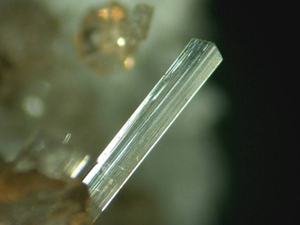
Bikitaite crystal, Foote Lithium Co. Mine, Kings Mountain, Cleveland County, North Carolina, USA (Source: mindat.org).


  Monoclinic or triclinic.
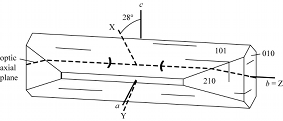
Occurs as prismatic crystals. Common forms: {001}, {101} and {010}.
Twinning on {010} always present
 
Physical properties:
 

Cleavage: {010} perfect
Hardness: 6.
D = 2.30-2.34 gm/cm3
Luster: vitreous.
Streak: white

 
Optical properties:                                                                                Bikitaite
 

Color: Colorless, white, pinkish, yellowish, red. Colorless in thin section.
Biaxial (-). α = 1.509, β = 1.520, γ = 1.522. δ= 0.013. 2Vx = 45 °. Z=b, X ? c 28 °. O.A.P. || (010)
Dispersion: r < v

     
Crystallography:
 

Unit cell:
a 8.606 Å, b 4.962 Å, c 7.600 Å, β 114.45 °, Z=2, Space group P21 (Kocman et al.1974).
and a 8.606 Å, b 4.953 Å, c 7.599 Å, α 89.89 °, β 114.42 °, γ 89.96 °, Z=2, Space group P1 (Ståhl et al. 1989)

Name:  
  Bikitaite was described and named by Hurlbut (1957) for the locality, Bikita, Fort Victoria, Zimbabwe. It is a rare zeolite occurring in two known localities, as an alteration product of spodumene in lithium-rich pegmatite dikes.
       
Crystal structure:  
 

Bikitaite is either triclinic (Bissert and Liebau 1986; Ståhl et al. 1989; Quartieri et al. 1999) or monoclinic (Kocman et al. 1974; Bissert and Liebau 1986). The framework of bikitaite can be constructed from puckered six-membered ring sheets of the tridymite type, where up and down tetrahedra alternate (see BIK). These sheets parallel to (001) have pyroxene tetrahedral chains above and below extending parallel to the b-axis, connecting two neighboring sheets (accompanying figure). BikitaiteThe orientation of the sheets agrees with the observed morphology and perfect cleavage. The structure is characterized by channels parallel to the b-axis delimited by deformed eight-membered rings (aperture 2.8 x 3.7 Å). Half of the tetrahedra in the six-membered ring sheets are occupied by Al (green in the figure), well ordered in triclinic and disordered in monoclinic bikitaite, whereas tetrahedra in the pyroxene chains are only occupied by Si. It is not understood as yet whether short range (Si,Al) ordering is preserved within the sheets of monoclinic bikitaite (Bissert and Liebau, 1986).
Li (red) is close to the walls of the b-extended channels and bonds to three framework oxygens of Al tetrahedra and to one H2O molecule (blue, see the center channel of the figure). The arrangement of H2O molecules forming hydrogen-bonded H2O chains parallel to the b-axis was investigated by Ståhl et al.(1989), Quartieri et al. (1999) and Kolesov and Geiger (2002). Dehydration induces only minor distortions in the framework, showing the lowest heating-induced distortion among zeolites up to now (Ferro et al. 2004 and Ceriani et al. 2004). Upon compression, the positions of the extra-framework cations and H2O molecules were maintained preserving the configuration of the water chains (Ferro et al. 2002, Comodi et al. 2003 and Seryotkin 2016)

     
Chemical composition:
  The chemical composition of bikitaite is simply a lithium aluminum silicate with no other detectable elements, and is the same at both known localities. From the several analyses of bikitaite from type locality, it appears that the framework composition may vary between [Al2.01Si3.99O12] and [Al2.13Si3.87O12] (Ståhl et al. 1989). Other cations are either not present or very minor, and the amount of H2O should be close to 9.0 weight percent.
       
Occurrences:
 

Bikitaite occurs in areas of hydrothermally altered spodumene-bearing pegmatite dikes, one in Zimbabwe and the other at the Foote Mine, King's Mountain, North Carolina, USA. The type area for bikitaite is a major pegmatite dike about 65 km east of Fort Victoria, Zimbabwe. The main lithium minerals in the dike are petalite and lepidolite along with spodumene and amblygonite. Fine-grained aggregates of eucryptite and quartz replace petalite, and bikitaite is still later forming in fractures, possibly replacing eucryptite (Hurlbut 1957).

The Foote Mine pegmatite consists largely of microcline, albite, quartz, spodumene, and muscovite. Local, late-stage hydrothermal alteration along fractures and brecciated zones resulted in the precipitation of bikitaite along with quartz, apatite-(CaF), rhodochrosite, and fairfieldite (Leavens et al. 1968). Recently, Bikitaite was reported from La Mareta and Tajao, Tenerife, Canary Islands, Spain (Dill et al. 2023).
References:  
 

Bissert, G. and Liebau, F. (1986) The crystal structure of a triclinic bikitaite, LiAlSi2O6 • H2O, with ordered Al/Si distribution. Neues Jahrb. Mineral., Monatsh. 1986, 241-252.

Ceriani, C., Fois, E., Gamba, A., Tabacchi, G., Ferro, O., Quartieri, S., Vezzalini, G. (2004) Dehydration dynamics of bikitaite: Part II. Ab initio molecular dynamics study. Am. Mineral. 89(1), 102-109.

Comodi, P., G.D. Gatta, P.F. Zanazzi (2003) Effects of pressure on the structure of bikitaite. Eur. J. Mineral. 15, 247-255.

Ferro, O., Quartieri, S., Vezzalini, G., Ceriani, C., Fois, E., Gamba, A. and Cruciani, G. (2004) Dehydration dynamics of bikitaite: Part I. In situ synchrotron powder X-ray diffraction study. Am. Mineral., 89 94-101.

Ferro, O., Quartieri, S., Vezzalini, G., Fois, E., Gamba, A. and Tabacchi, G., (2002) High-pressure behavior of bikitaite: An integrated theoretical and experimental approach. Am. Mineral., 87, 1415-1425.

Hurlbut, C.S., Jr. (1957) Bikitaite, LiAlSi2O6 • H2O, a new mineral from Southern Rhodesia. Am. Mineral. 42, 792-797.

Kocman, V., Gait, R.I., and Rucklidge, J. (1974) The crystal structure of bikitaite, LiAlSi2O6 • H2O. Am. Mineral. 59, 71-78.

Kolesov, B.A. and Geiger, C.A. (2002) Raman spectroscopic study of H2O in bikitaite: "One-dimensional ice". Am. Mineral., 87 1426-1431.

Leavens, P.B., Hurlbut, C.S., Jr., and Nelen, J.A. (1968) Eucryptite and bikitaite from King's Mountain, North Carolina. Am. Mineral. 53, 1202-1207.

Quartieri, S., Sani, A., Vezzalini, G., Galli, E., Fois, E., Gamba, A., and Tabacchi, G. (1999) One-dimensional ice in bikitaite: Single-crystal X-ray diffraction, infra-red spectroscopy and ab-initio molecular dynamics studies. Microporous Mesoporous Mater. 30, 77-87.

Seryotkin, Y.V. (2016) Evolution of the bikitaite structure at high pressure: A single-crystal X-ray diffraction study. Microporous Mesoporous Material., 226, 415-423.

Ståhl, K., Kvick, A., and Ghose, S. (1989) One-dimensional water chain in the zeolite bikitaite; neutron diffraction study at 13 and 295 K. Zeolites 9, 303-311.

Updated: April 2025.