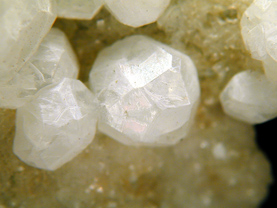
Occurs as a replacement of analcime
Hardness: not determined
Density: 2.29 g/cm3
Luster: vitreous
Streak: white
Isotropic
n 1.518
δ = 0.001
| Ammonioleucite | |(NH4,K)| [AlSi2O6] | |
|
| Morphology: | |||
| Tetragonal Occurs as a replacement of analcime |
|||
| Physical properties: | |||
| Fracture:
subconchoidal Hardness: not determined Density: 2.29 g/cm3 Luster: vitreous Streak: white |
|||
| Ammonioleucite from Tataruzrwu, Fujioka, Japan. Toni Wieland Collection (© Volker Betz). | |||
| Optical properties: | |||
| Color:
colorless, white Isotropic n 1.518 δ = 0.001 |
|||
| Crystallography: | |||
| Space Group: I41/a | |||
| Unit cell: a 13.214 Å c 13.713 Å | |||
| Z = 16 | |||
| Name: | |||
| Hori et al. (1986) named the mineral for its composition and structural relationship with leucite. The type locality is in the Sanbagawa metamorphic belt, Tatarazawa, Fujioka, Gunma Prefecture, Japan. | |||
| Crystal structure: | |||
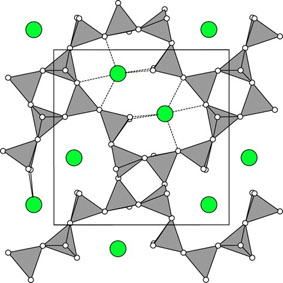
| Because the X-ray powder diffraction pattern of ammonioleucite is similar to that of tetragonal leucite, Hori et al. (1986) concluded that the two minerals are isostructural. All single crystals are twinned in the same manner as leucite, but sufficient reflections were obtained to determine the space group as I41/a. The unit cell dimensions were calculated from the powder pattern. The figure here is a representation of the crystal structure of leucite (framework-type ANA) and probably the same as the structure of ammonioleucite with the NH4+ cations occupying the K+ sites (green). Yamada et al. (1998) confirmed this structure through Rietveld analysis of X-ray powder diffraction data. Characterization of ammonioleucite and its deuterated form using IR spectroscopy and Rietveld refinement was reported by Andrut et al. (2004). |
|
||
| The structure of tetragonal leucite of Mazzi et al. (1976) 0 < z < 0.25, to illustrate the approximate structure of ammonioleucite. The ammonium cations (green circles) occupy the K sites of leucite (or the H2O sites of analcime), and are coordinated with six framework oxygen atoms (five are shown). | |||
| Chemical composition: |
| The composition is that of the ammonium-analog of leucite. The only other element in the type locality material is minor potassium. However, Tl has been found in the only other known ammonioleucite from a deep-sea occurrence (Nishida et al. 1997). An infrared absorption spectrum from the type material showed that the crystals contain no zeolitic water. |