Cumene cracking was carried out in the conditions described (N. Katada, Y. Kawaguchi, K. Takeda, T. Matsuoka, N. Uozumi, K. Kanai, S. Fujiwara, K. Kinugasa, K. Nakamura, S. Suganuma and M. Nanjo, Appl. Catal., A: Gen., 530, 93 (2017).). Powder zeolite sample (10 mg) was placed in a Pyrex tube (4 mm i.d.), and pre-treated in a helium flow (34 µmol·s-1, atmospheric pressure) at 773 K for 1 h. Cumene (98%, C87657-1L, lot# BCBT6047 purchased from Sigma-Aldrich as designated, without purification, 7.2 µmol) was then injected at 523 K in the helium flow from the septum at the inlet of reactor, and the eluted products were analyzed by a FID (flame ionization detector)-GC (gas chromatograph) connected to the outlet of the reactor.
1,3,5-Triisopropylbenzene cracking was done in the same reactor (4 mm i.d.) with 10 mg of the powder zeolite sample after the pre-treatment in a helium flow (20 µmol·s-1 at atmospheric pressure) at 773 K for 1 h. The reaction temperature was 673 K, and the amount of injected 1,3,5-isopropylbenzene (Tokyo Chemical Industry Co. Ltd., Extra Pure) was 4.1 µmol, as shown in our previous paper (D. Mitsuyoshi, K. Kuroiwa, Y. Kataoka, T. Nakagawa, M. Kosaka, K. Nakamura, S. Suganuma, Y. Araki and N. Katada, Micro-. Mesopor. Mater., 242, 118 (2017).).
Reactant |
Sample weight (mg) |
Conversion of reactant |
Material balance |
Cumene |
9.9 |
0.788 |
1.111 |
1,3,5-TIPB |
10.1 |
0.782 |
1.044 |
By the reaction of cumene, benzene and propene were formed, whereas small amounts of cumene and 1,3-diisopropylbenzene [1,3-bis(1-methylethyl)benzene] were detected in addition to the major products, i.e., benzene and propene. In both cases, the conversion of reactant is shown by (FID intensity of products) / (FID intensity of products and recovered reactant). In addition, the material balance was estimated from (FID intensity of products and recovered reactant) / (FID intensity of equivalent reactant separately injected from septum at the outlet of reactor).
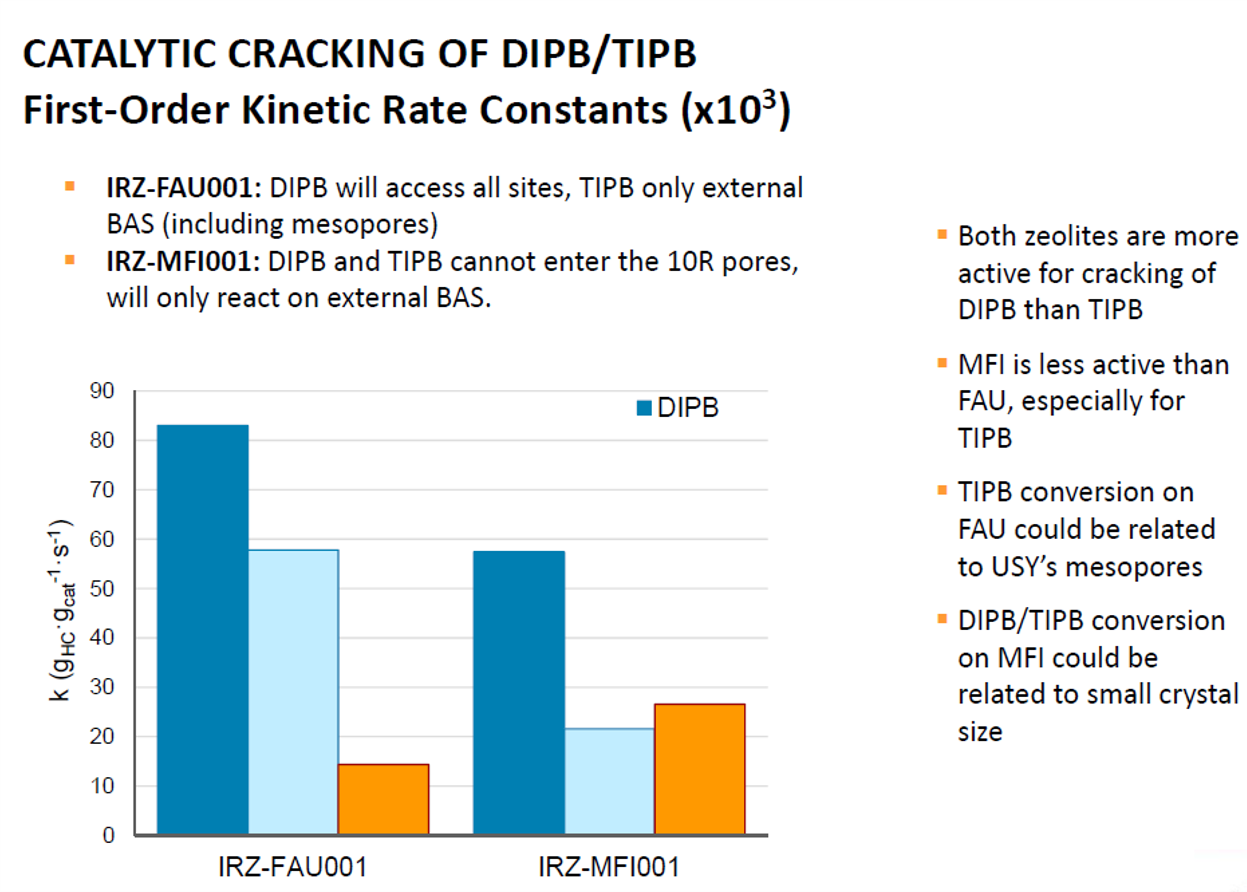
The activity for cumene cracking was MFI > FAU, whereas that for 1,3,5-triisopropylbenzene cracking was FAU > MFI. The low material balance found in the cumene cracking on FAU indicates that considerable amount of reactant and/or intermediate was converted into carbonaceous. It is speculated that such coking in this reaction proceeded via polycyclic aromatic hydrocarbons, which was difficult to be formed due to the steric hindrance in the small micropores in MFI.
Reaction system: MAT unit (fully automated fix-bed reactor),
T = 500 ºC, TOS = 60 s, mcat = 0.2 g, cat/oil = 0.9-1.8 g·g-1.