n-Heptane Cracking over IRZ-FAU001

Data 1. provided by Johannes Lercher Group

Catalysis experiments
The protolytic cracking of n-pentane and n-heptane were conducted in a tubular flow reactor with a quartz tube with an internal diameter of 7 mm at ambient pressure. Catalyst pellet (300 - 500 µm) were activated in situ at 813 K with a heating ramp of 10 K min-1 for 1 h in 20 ml min-1 synthetic air and then flushed for 30 min with 20 ml min-1 N2. The reactant stream was introduced into the reactor via an evaporator, using N2 as a carrier gas. The reaction was carried out between 733 and 793 K. The molar ratio between N2 and n-heptane was kept at 100. Reactant and products were separated and analysed by on-line chromatography (Superlco Q-Plot, capillary column: 30 m × 0.53 mm × 2.0 µm) using an FID detector.

npentane001   npentane002
Pathway
TOF*
(mmol·molBAS-1·s-1)
Apparent activation energy
(kJ·mol-1)
Apparent activation entropy
(J·mol-1·K-1)
753 K
773 K
793 K
C1 + C6=
0.039
0.075
0.13
155
-77
C2 + C5=
0.060
0.10
0.17
129
-107
C3 + C4=
0.063
0.10
0.18
130
-106
C4 + C3=
0.10
0.20
0.33
149
-76
C5 + C2=
0.084
0.16
0.28
148
-79
Overall cracking
0.35
0.63
1.1
143
-74
Dehydrogenation*
0.10
0.24
0.43
177
-38

*Calculation of TOF based on yield of alkane in each pathway, assuming that all the produced alkanes do not crack.
*Dehydrogenation quantified by the total hydrogen balance.

Notes
The overall apparent activation energy of 143 kJ/mol and the estimated heat of adsorption of 61 kJ/mol on the FAU sample lead to a true activation energy of 204 kJ/mol, well in agreement with previous experiments. Similarly, the true energy of activation (238 kJ/mol) is on the high side, but within the limits of previously reported data.


Data 2. provided by Keiichi Tomishige Group

Catalysis experiments
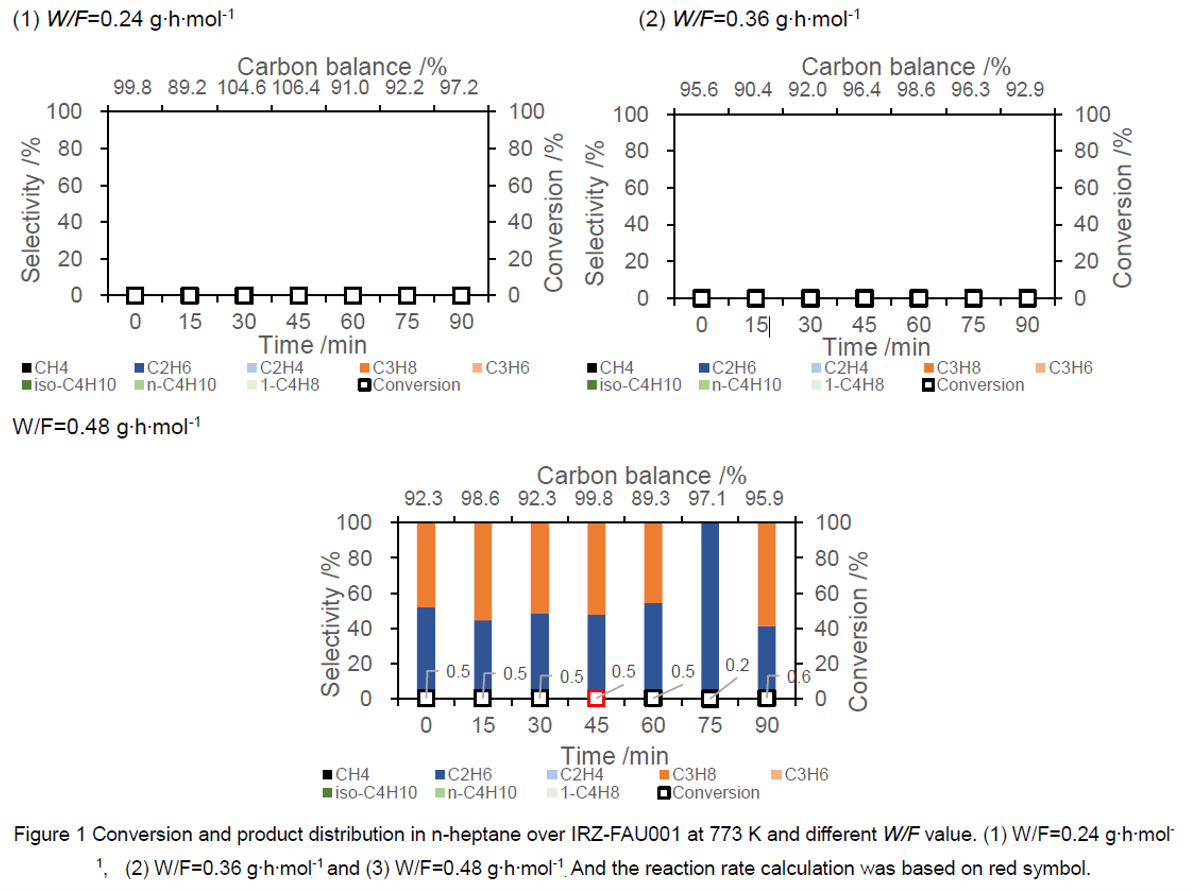
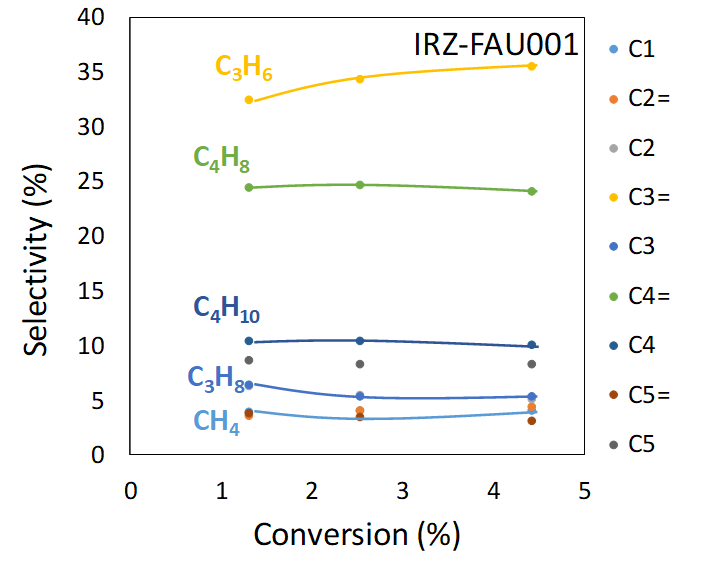
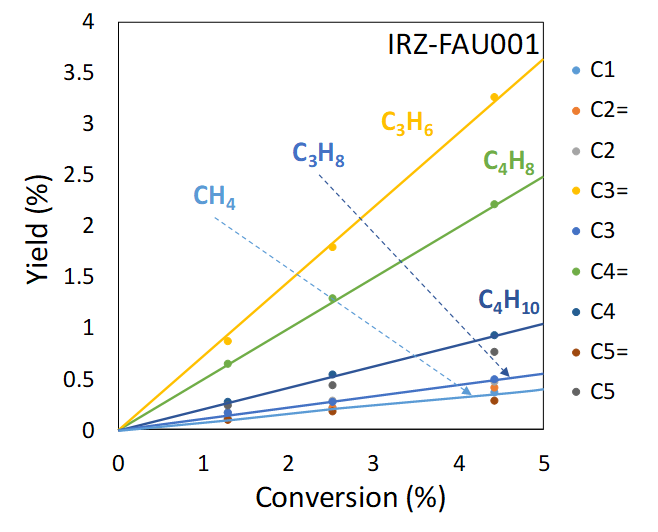
n-heptane (Wako, > 99 %) was used as the reactant. The catalytic cracking of n-heptane was carried out in a continuous flow fixed bed reactor. Nitrogen was used as a carried gas. Each reaction condition was listed in the supplementary part. A syringe pump was used for the feeding of n-heptane. Both of USY (IRZ-FAU001) and ZSM-5 (IRZ-MFI001) were pressed, crushed and sieved to 150-250 μm granules and then a 15-100 mg catalyst was loaded and sandwiched by two layer of silica wool in the reactor (The diameter of glass pipe was 4 mm). Depended on the type of catalysts, the heights of catalyst bed of 50 mg USY and ZSM-5 were 9mm and 7mm, respectively. Before reaction, the catalyst was pretreated in a 50 ml/min nitrogen stream at 813 K for 1 h and then was cooled down to the reaction temperature 773 K. In the activity test, n-heptane conversion at 5 min after introduction the reactant to the catalyst bed was measured as initial conversion and reaction was carried for 90 min. The mole ratio between nitrogen and n-heptane was kept at 100.
The unreacted n-heptane at reactor outlet was analyzed using gas chromatograph (GC-2025, Shimadzu) equipped with an FID detector using a capillary column (DB-35), one of the products methane was analyzed using a GC-14B equipped with FID detector (Gaskuropack 54) and other gaseous products (C2, C3 C4) were analyzed by GC-14 equipped with TCD detector (Unipak S).
The conversion, selectivity and carbon balance were calculated by flowing substrate (Flowi) and defined by following equations:
Conversion = Σαi×Flowproduct-i / (Σαi×Flowproduct-i+7×Flown-heptane-out);
Selectivityproduct-i = αi×Flowproduct-i/Σαi×Flowproduct-i;
Carbon balance = (αi×Flowproduct-i+7×Flown-heptane-out)/(7×Flown-heptane-in);
Reaction rate was based on formation rate of products:
Rate = Σ×Flowproduct-i

W/F
g·h·mol-1
Conversion
%
Selectivity / %
Rate
mmol·min-1
CH4
C2H6
C2H4
C3H8
C3H6
iso-C4H10
n-C4H10
C4H8
0.24
0
0
0
0
0
0
0
0
0
0
0.36
0
0
0
0
0
0
0
0
0
0
0.48
0.5
0
47.9
0
58.6
0
0
0
0
5.2×10⁻⁴
npentane003