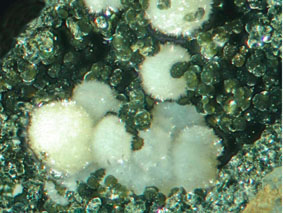
Cowlesite |Ca(H2O)5.3| [Al2Si3O10]
Cowlesite on saponite-chlorite, Yacolt, Clark County, Washington, USA
     
Morphology:  
  Orthorhombic
Occurs as hemispheres of delicate,
very thin blades
Common forms:  {010}, {101} and {100}
 
Physical properties:
  Cleavage: {010} perfect
Hardness: 5 - 5½
Density:  2.14(2) g/cm3
Luster: pearly
Streak:  white
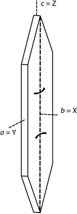
   
Optical properties:            
  Color:  colorless, white
Biaxial (-)
α = 1.505-1.513, β = 1.509-1.516,
γ = 1.509-1.518, δ = 0.005
2Vx = 30-53°
X = b, Y = a, Z = c
O.A.P. || (010)
Dispersion: none
 
Crystallography:
  Unit cell: a 23.116 Å
b 24.891 Å
c 30.468 Å

Space Group: Ccma (Mugnaioli et al. 2020)
  Z = 52  
       
Name:  
  Cowlesite was described and named by Wise and Tschernich (1975) to honor John Cowles of Rainier, Oregon, amateur mineralogist. The type material comes from road cuts 0.65 km northwest of Goble, Columbia County, Oregon, USA.
       
Crystal structure:  
Barrerite The extreme thinness of the crystals and stacking of plates have prevented a determination of the structure for a very long time. Recently, ab initio structure determination of this mineral was obtained by three-dimensional electron diffraction from single-crystal domains of a few hundreds of nanometers (Mugnaioli et al. 2020). The structure of cowlesite consists of an alternation of rigid zeolitic layers and low-density interlayers supported by water and cations. This makes cowlesite the only two-dimensional zeolite known in nature. The structure of a single layer can be decomposed in just two independent building units (CBU), a d6r (12T) and a heavily distorted imf (16T), the latter never observed in natural zeolites. Two additional T atoms are connected with both d6r and imf and are responsible for the interlayer Si–O–Si bridging (Mugnaioli et al. 2020).
When cowlesite gets in contact with a transmission electron microscope vacuum, a phase transition to a conventional 3D zeolite framework occurs in a few seconds. The original cowlesite structure could be preserved only by adopting a cryo-plunging sample preparation protocol. Continuous loss of loosely bonded water from cowlesite interlayer destabilizes the Ca-rich interlayer and triggers the phase transition toward a 3D zeolitic framework around 411 K at ambient pressure (Mugnaioli et al. 2020).
   
Chemical composition:
  In a review of the crystal chemistry of cowlesite Vezzalini et al. (1992) reanalyzed the samples in the original description by Wise and Tschernich (1975) and new ones from many Northern Ireland localities. A selection of analyses are presented in Deer et al. (2004). The striking feature of all the analytical data is the constancy of the cowlesite composition. TSi (fraction of Si in tetrahedral sites) varies between 0.60 and 0.62 (Si/Al, 1.50 to 1.65), and the dominant cation is Ca. Among the minor constituents Na is present in all samples, comprising up to 1.86 cations per formula unit, based on 60 oxygen anions (Kuwano and Tokumaru 1993). K, Mg, Sr, and Ba are detectable in most samples, but are present in minor amounts. However, the cowlesite recently found in a pegmatite dike on Suoluaiv Mountain, Lovozero, Russia, contains 1.48 Sr cations (in a formula unit of 60 oxygen anions) (Pekov 2000).
   
Occurrences:  
  Cowlesite is a scarce zeolite occurring as a low temperature alteration product of basaltic rocks. One of the more important controls on its crystallization is the composition of the host basalt. Since cowlesite is a low silica zeolite, it forms mostly in cavities of low-silica lavas. Tschernich (1992) observes that cowlesite is commonly found in rocks that also contain levyne. For example, in Iceland cowlesite occurs in cavities of olivine basalt and is commonly associated with levyne, thomsonite, and chabazite. Although cowlesite has not been found in drill cores from geothermal wells in Iceland, levyne and chabazite have, and form at temperatures below 70°C.
  Since the original description reporting cowlesite occurrence in several localities in the western U.S. and British Columbia, Canada, it has been reported from many other basalt localities. It was widespread in Northern Ireland (Nawaz 1984; Vezzalini et al. 1992) and in much more restricted occurrences in the Faeroe Islands (Betz, 1981); Kingsburgh, Scotland (Gottardi and Galli 1985); Cairns Bay, Victoria, Australia (Birch 1989); Oki Islands, Japan (Matsubara et al. 1978; Matsuyama and Matsubara 2000); and Mt. Adamson, Antarctica (Galli et al. 1995).
  Cowlesite occurs as a hydrothermal mineral in the Seidozeritovoye pegmatite at Suoluaiv Mountain, Lovozero massif, Kola Peninsula, Russia (found by N.V. Chukanov, reported in Pekov, 2000). It forms pink crystals intergrown with analcime and as yellowish crystals in cavities in aggregates of gonnardite.
       
References:  
 

Betz, V. (1981) Zeolites from Iceland and the Faeroes. Mineral. Rec. 12, 5-26.

Birch, W.D. (1989) Chemistry of Victorian zeolites, in Birch, W.D. Zeolites of Victoria, Mineral. Soc. Victoria (Australia), Sp. Pub. No. 2, 91-102.

Deer, A., Howie, R., Wise, W.S,. and Zussman, J. (2004). Rock Forming Minerals. vol. 4B.
Framework Silicates: Silica Minerals, Feldspathoids and the Zeolites
. The Geological Society, London.

Galli, E., Quartieri, S., Vezzalini, G., and Alberti, A. (1995) Boggsite and tschernichite-type zeolites from Mt. Adamson, Northern Victoria Land (Antarctica). Eur. J. Mineral. 7, 1029-1032.

Gottardi, G. and Galli, E. (1985) Natural Zeolites, Springer-Verlag, Berlin, Germany. 409 pp.

Kuwano, S. and Tokumaru, S. (1993) Some zeolites from Chojabaru, Iki Island, Nagasaki Prefecture, Japan: with special reference to occurrence of cowlesite and gobbinsite (in Japanese with English abstract). Geoscience Mag. 42, 159-167.

Matsubara, S., Tiba, T,. and Kato, A. (1978) The occurrence of cowlesite from Kuniga, Oki Islands, Japan. Bull. Nat. Sci. Mus. Ser. C 4, 33-36.

Matsuyama, F. and Matsubara, S. (2000) Gobbinsite from Kuniga, Dozen, Oki Islands, Shimane Prefecture, Japan. Japan. Mag. Mineral. Petrol. Sci. 29, 129-135.

Mugnaioli, E., Lanza, A. E., Bortolozzi, G., Righi, L., Merlini, M., Cappello, V., Marini, L., Athanassiou, A., Gemmi, M. (2020) Electron diffraction on flash-frozen cowlesite reveals the structure of the first two-dimensional natural zeolite. ACS Cent. Sci., 6, 1578-1586.

Nawaz, R. (1984) New data on cowlesite from Northern Ireland. Mineral. Mag. 48, 565-566.

Pekov, I.V. (2000) Lovozero Massif: History, Pegmatites, Minerals. Ocean Pictures Ltd., Moscow, Russia. 484 pp.

Vezzalini, G., Artioli, G., Quartieri, S., and Foy, H. (1992) The crystal chemistry of cowlesite. Mineral. Mag. 56, 575-579.

Tschernich, R.W. (1992) Zeolites of the World. Geoscience Press, Tucson, Arizona, 562 pp.

Wise, W.S. and Tschernich, R.W. (1975) Cowlesite, a new Ca-zeolite. Am. Mineral.60, 951-956.

Updated: May 2025.